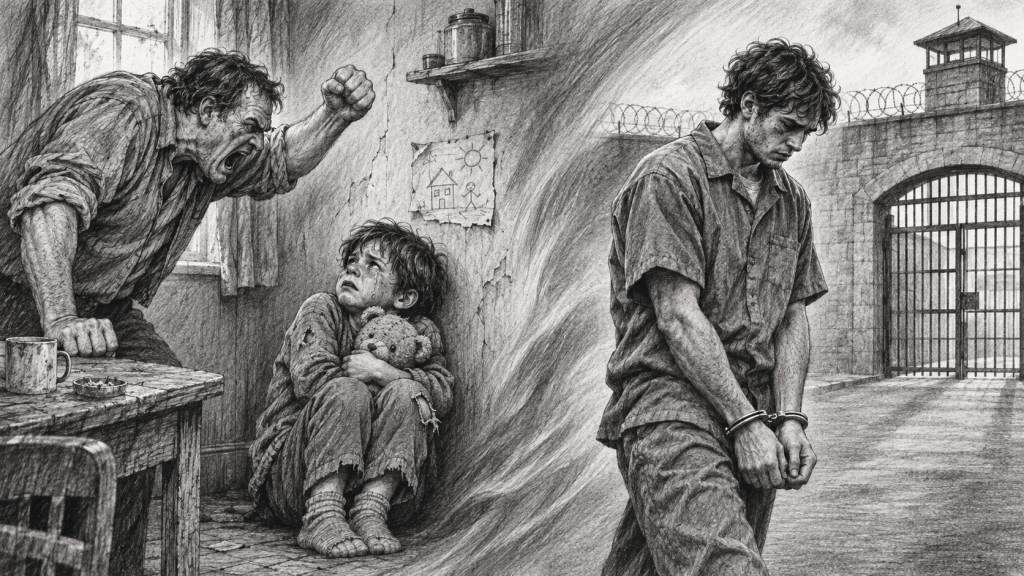
We are remarkably quick to judge people by what we see on the surface, yet far less interested in understanding the experiences, circumstances and influences that have shaped their lives and contributed to their present circumstances. Drawing on my experience teaching young offenders, my own childhood and scientific research, I want to ask an uncomfortable question: what if understanding human behaviour — and preventing some of its most destructive consequences — requires us to look much further beneath the surface?
The Monsters We Create in Our Minds
Some of you who have been reading Eccentricize for a while will know that I am bilingual and hold dual citizenship: Polish by birth and British by choice. I left Poland at the age of twenty-eight, and I dare say it was one of the best decisions I have ever made. Sometimes I wish I had left even earlier! Britain has given me opportunities I treasure enormously: a career in education, the possibility of owning my own home, the freedom to live independently, and the means to travel the world and explore different dimensions of myself — intellectual, creative, athletic, philosophical and, hopefully, entrepreneurial.
Over the years, my ties with Poland have become increasingly loose. Nevertheless, occasional news reaches me, especially when I venture onto Facebook to sell something on Marketplace and end up looking at the newsfeed. Recently, Poland has been shaken by several appalling acts of violence. In October 2026, a fifteen-year-old fatally attacked a school employee near Wyszków. The following month, a twenty-four-year-old gunman killed six people in Kraków’s historic centre, leaving many others injured. Three members of his family were also discovered dead, and investigators are examining the circumstances. These are horrifying tragedies, and my thoughts are first and foremost with the victims and their families.
Yet something else disturbed me as I read the online reactions. Comment after comment condemned the perpetrators as monsters, beasts, psychopaths, devils or creatures possessed by evil. Some demanded the harshest imaginable punishment. There was fury, disgust, hatred and very little curiosity about what might have happened in these young men’s lives before the violence. Of course, online comment sections are hardly a representative survey of Polish society. But the recurring language caught my attention because it revealed a familiar tendency: we are very quick to judge the final outcome and remarkably reluctant to investigate the underlying process that produced it.
Please don’t misunderstand me. I am not defending murderers, minimising their crimes or suggesting that a difficult childhood absolves anyone of responsibility. The victims cannot be brought back by discovering what went wrong in a perpetrator’s life. Justice and accountability matter. But I also believe that calling someone a monster is intellectually convenient. It allows us to place the person outside the boundaries of normal, respectable humanity, as though violence were the exclusive property of some freaks of nature. Once we have established that somebody is a beast, we can stop analysing. Pigeonholing is easy, definitely easier than reflecting. We have our simplistic explanation. The case is closed — at least in our minds. But is it really? What if the question we should be asking is not simply, “What kind of monster would do this?” but “What combination of experiences, struggles, circumstances, failures, influences and missed opportunities brought this human being to this point?”
We See the Smoke, but Rarely Investigate the Cause of the Fire
I have long been fascinated by our tendency to focus on the visible manifestations of problems rather than their underlying causes. We see a serious illness, a destructive addiction, a violent offence, a broken relationship or a young person whose behaviour has become unacceptable. We name the problem, speculate about it, condemn it, medicate it, punish it, manage it or attempt to repair the damage. Sometimes all those responses are necessary. But how often do we rewind the story and investigate the conditions in which the problem developed?
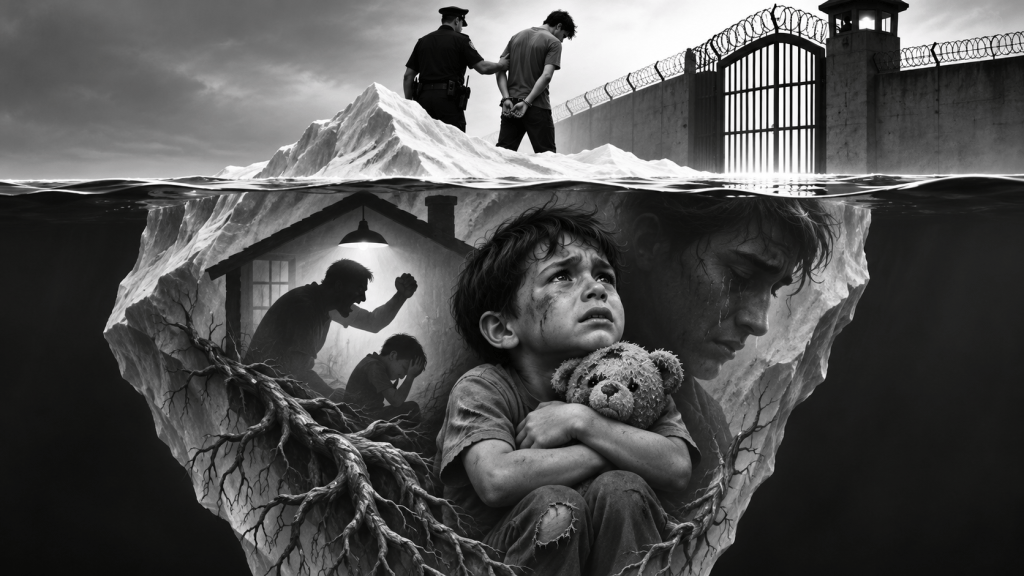
I like to think of this as an iceberg. Above the waterline sits the visible and palpable outcome: the behaviour, the diagnosis, the crime, the crisis, the breakdown. Beneath the surface lies a complicated invisible landscape of experiences and influences that may have accumulated for years. Childhood relationships, habits, social expectations, education, genetics, opportunities, stress, environment, emotional resources and unhealthy conditioning may all have contributed. The proportions vary from person to person. Some factors are beyond our control; others are choices for which we must take responsibility. Understanding them requires more effort than simply looking at the part we can see.
This applies across many areas of life, although not in identical ways. In health, for example, we may see the eventual consequences of habits, biological vulnerabilities and living conditions that have developed over decades. In education, we may see a disruptive pupil without recognising emotional and psychological difficulties that have been developing and accumulating for years. In criminal justice, we encounter the offender after the damage has occurred. In each situation, there is a temptation to treat the outcome as the beginning of the story, when it may actually be one of its final chapters — the last straw that broke the camel’s back. Do we rewind and investigate how much weight the camel had to carry? What were all those straws? We are a society obsessed with judging the rotten fruit, yet remarkably uninterested in examining the contaminated soil in which it grew.
I wonder whether our education systems spend enough time teaching young people to think in terms of causes, consequences and interconnected responsibilities. We teach children rules, facts, formulas, and definitions. We tell them that violence is wrong, but how deeply do we explore the development of aggression, emotional regulation, family relationships and the gradual accumulation of resentment? We teach them about health, but do we consistently develop their ability to understand the consequences of long-term habits?
Root-cause thinking is not a new invention, of course. Researchers, educators and public-health specialists have been examining these questions for decades. My concern is whether this thinking has become sufficiently central to how ordinary people understand themselves and others.
What Happens When a Child Grows Up Without Love?
I am particularly interested in childhood because I believe it is one of the most important foundations of adult life. By love, I don’t mean sentimental declarations, occasional presents or a parent’s insistence that everything they do is for their child’s own good. I mean something much more substantial: affection, emotional safety, acceptance, patience, consistency, guidance, encouragement, respect and genuine interest in the developing person. A child needs more than food, clothing, a roof and access to education. A child needs to feel that their existence is welcome, that their questions matter, that their presence is not an irritation, and that mistakes will not automatically provoke comparison or humiliation. When the world becomes overwhelming, someone dependable should be there to help them make sense of it.
I write this from personal as well as professional experience. Some of the most intense anger, resentment and despair I have ever experienced belonged to the years when I lived in a home characterised by hostility, volatility and emotional abuse. I know what it feels like to be a child who doesn’t experience home as a place of refuge. I know how deeply repeated criticism, comparison to others, intimidation and rejection can affect the way a young person sees themselves and the world. And I know that people respond to such environments differently. Some withdraw. Some become anxious or depressed. Some develop destructive coping mechanisms. Some direct their anger inward, while others may direct it outward. Some seek escape through substances, self-harm or reckless behaviour. Others become extraordinarily resourceful and eventually build lives that look nothing like their beginnings.
An unhappy childhood is not a sentence to an unhappy adulthood, and childhood abuse does not make a person destined to become violent. Nevertheless, research consistently shows that adverse childhood experiences can increase the risk of later difficulties. A 2017 systematic review and meta-analysis involving more than 250,000 participants found particularly strong associations between multiple adverse childhood experiences and outcomes including problematic substance use, mental ill health, interpersonal violence and self-directed violence. A separate review of prospective studies found elevated odds of later violent behaviour among people who had experienced childhood maltreatment. These findings do not mean that childhood trauma explains every criminal act. They mean that childhood experiences deserve serious consideration when we discuss prevention.
The Emotional Bank Account: Were You Given 100 Units or a Debt of 100?
Imagine that every human being arrives in the world with an emotional bank account. A child raised in a nurturing, supportive environment might accumulate one hundred units of emotional wealth. They are loved, encouraged, protected and guided. Their curiosity is welcomed. Their mistakes become learning opportunities. Their parents help them develop confidence, emotional regulation and trust. As they grow older, they can draw upon these resources when life becomes difficult.
Now imagine a child raised in an emotionally neutral environment. Their basic needs are met, but genuine warmth, encouragement and meaningful emotional connection are scarce. For the sake of my metaphor, perhaps they begin adulthood with a balance close to zero. They have not been deliberately destroyed, but they have not been given much emotional capital either. Finally, imagine a child who grows up surrounded by anger, humiliation, intimidation, violence, neglect or rejection. Instead of accumulating resources, they repeatedly lose them. Their developing sense of self is undermined. Their confidence becomes fragile. They may internalise dysfunctional beliefs about relationships, safety and their own worth. By adulthood, rather than having one hundred units available, they might feel as though they are one hundred units in debt.
The figures are imaginary, of course. Human emotional development cannot be measured like a bank balance, and people are far more complicated than any numerical model. But the metaphor helps communicate something I find profoundly important: not everyone begins adult life with the same emotional resources. Some people start life with foundations, walls and a roof already in place. Others must first clear the rubble before they can even begin building. And rebuilding can take years. For me, it involved leaving an unhealthy environment, gaining independence, developing new perspectives, learning, travelling, experimenting and gradually constructing a life in which I could feel safe and free. It wasn’t an instant transformation. It was a long process of trying to replace damaging lessons with healthier ones.
Now imagine a young person who starts with that emotional debt but has no meaningful opportunity to rebuild. No trustworthy adult, no supportive relationships, no sense of competence or achievement, no constructive outlet for frustration, and no belief that a better future is possible. What happens then? There is no single answer, but surely the question deserves more attention than it usually receives.
The Classroom That Changed My Understanding of Criminals
For several years, I worked as a teacher in a secure educational setting, supporting young people with complex needs, including those who had committed extremely serious offences. My responsibility was to provide education, help students gain qualifications and develop practical skills that might support their eventual reintegration into society. I taught a wide variety of subjects and activities, including life skills, cooking, money management, arts and crafts, wellbeing, stress management and yoga. On paper, my role was educational. In reality, much of my work was also relational and therapeutic.
Many of the young people I encountered had experienced severe disruption, instability, loss, neglect or abuse. Some had struggled with substance misuse or profound difficulties regulating their emotions. Many appeared to have little faith in their future. They had been defined by their behaviour, their records and their offences for so long that imagining themselves as capable, productive people was often a considerable challenge. I was fortunate to work in an environment where understanding a student’s background was an important part of planning support. We had access to relevant professional assessments and case information. Those records were confidential, and I would never disclose their identifying details. But the broad patterns I encountered profoundly influenced my understanding of education and human behaviour.
My approach was relatively straightforward. I listened. I treated my students with dignity. I expected them to work, but I also encouraged them to believe that the work mattered. I wanted them to discover their capabilities, develop qualifications, learn practical skills and begin imagining a future in which their identity was not permanently determined by their former actions. Part of our professional responsibility as teaching staff was to avoid revisiting a young person’s crime during lessons. We were there to help them improve and grow academically, not to trigger distress. Other specialists had the expertise and remit to address those matters. My focus was on helping them discover what they could still learn, develop a can-do attitude and a growth mindset, achieve and contribute.
Occasionally, a student would tell me that our practical lessons were among the most emotionally beneficial parts of their week. That meant an enormous amount to me. I wasn’t providing psychotherapy; I was teaching and offering mentoring and coaching. I would smuggle motivational quotes into our lessons, along with golden nuggets of hope and positivity. I came to appreciate that an educational relationship characterised by respect, predictability, patience and genuine interest could itself be deeply meaningful. Sometimes learning to use a sewing machine, preparing a meal, completing a qualification or creating a piece of art meant a lot to a young person. It offered evidence that the young person could accomplish something worthwhile and a glimpse of a creative identity.
Face to Face with a Murderer
I will never forget the apprehension I felt when I learned that a young boy who had taken another person’s life was about to join our secure unit. I had worked with challenging young people before, but this was different. For some of us, it would be our first encounter with a person who had committed murder, and the prospect was deeply unsettling. As teaching and support staff, we had access to relevant background information about our students, including their histories and the offences that had brought them into secure care. Reading about such an offence on paper was one thing; knowing that I would soon be sitting across a classroom table from the person who had committed it was quite another.
I would be lying if I said I wasn’t uneasy. My colleagues were uneasy too. I remember how apprehensive we felt as we prepared for his arrival and how carefully we approached those initial sessions. I was accustomed to teaching practical subjects, including activities involving sewing machines, cooking equipment and other tools, so naturally we had to consider safety and follow the necessary procedures. Initially, our lessons involved several members of staff, and there was an understandable atmosphere of caution. We were professionals, but we were also human beings, and knowing that a student had taken another person’s life could not help but influence our expectations.
And then something remarkable happened. As I began working with him and getting to know him as a student, the frightening image I had constructed in my mind gradually disappeared. He turned out to be one of the loveliest students I had ever taught. He was hardworking, cooperative, dedicated and genuinely pleasant to have in class. He engaged enthusiastically with practical activities, responded to encouragement and showed a willingness to learn that I found enormously rewarding. As trust developed and professional assessments and procedures allowed, we became increasingly comfortable working with him individually. The atmosphere of apprehension that had surrounded his arrival was replaced by a productive and positive educational relationship.
I still remember how striking that transformation felt. Here was a young person who had committed murder, and yet the student I encountered in my classroom possessed qualities that I would ordinarily associate with kindness, warmth and dedication. I am not suggesting that his offence was somehow less serious because he behaved well in lessons. Someone had lost their life, and nothing about my positive experience could erase that reality. But it taught me something I have never forgotten: a person can commit an appalling act and still possess qualities that contradict the simplistic image of a monster. Human beings are complicated, and knowing the worst thing someone has done does not necessarily mean we understand the whole person.
That experience also challenged some of my assumptions about rehabilitation. I began to understand why respect, consistency, encouragement and meaningful opportunities were so important in our work. Many of our students had experienced repeated rejection, instability or failure. Some had come to believe that their future was already written and that there was little point trying to achieve anything. Yet in the classroom I saw young people develop skills, complete qualifications, discover interests and begin to imagine possibilities beyond their immediate circumstances. None of this guaranteed that they would never offend again, and I would never claim that education alone could solve every problem. But I believed then, as I do now, that giving someone a reason to develop themselves is considerably more constructive than continually reminding them that society expects nothing worthwhile from them.
What Does Science Tell Us About the Roots of Violence?
My professional experiences were personal observations, not a scientific study. I worked with a particular group of young people in a particular environment, and it would be irresponsible to claim that every murderer or violent offender shares the same developmental history. Nevertheless, what I witnessed is consistent with an important body of research examining the relationship between childhood adversity, social environments and later behavioural difficulties. The US Centers for Disease Control and Prevention identifies multiple risk factors for youth violence, including exposure to family conflict, violent victimisation, harsh or inconsistent discipline, poor family functioning, social rejection and association with delinquent peers. It also identifies protective factors such as strong relationships with family members or other trusted adults, social competence, educational aspirations and supportive school environments.
These influences operate at several levels. Some concern individual characteristics, while others involve families, schools, communities and wider social conditions. There is rarely one simple explanation for a violent act, and it would be especially misleading to assume that childhood adversity inevitably produces criminal behaviour. Most children who experience maltreatment do not become violent offenders. Nevertheless, when adverse experiences are associated with increased risks, surely it makes sense to examine those experiences rather than dismiss them as irrelevant to the discussion. The purpose is not to predict that an abused child will become a murderer, but to understand which factors can place children at greater risk and which interventions might help protect them.
Importantly, scientific research does not stop at identifying risk factors. Some prevention programmes have produced measurable long-term benefits. One randomised trial investigated the effects of nurses visiting families during pregnancy and early childhood. At the fifteen-year follow-up, adolescents from certain higher-risk families who had received the intervention reported fewer arrests and convictions than comparable young people in control groups. We cannot assume that every early-intervention programme will achieve identical outcomes, and the results of any individual study have limitations. Nevertheless, the findings illustrate a principle I consider enormously important: support offered during the earliest stages of a child’s life can potentially influence outcomes many years later.
The World Health Organization and its partners have also developed INSPIRE, an evidence-informed framework for preventing violence against children. Its strategies include supporting parents and caregivers, creating safer environments, improving access to services, strengthening economic security, and developing education and life skills. In other words, preventing violence is not merely a sentimental aspiration. It can involve practical interventions that are implemented, evaluated and improved. We cannot prevent every tragedy, but that should not discourage us from investigating which forms of prevention are effective.
Responsibility Does Not End with the Perpetrator
Here is where my argument may become controversial. I believe that serious violence is not exclusively a matter for the individual offender and the criminal justice system. We have a collective responsibility to create conditions in which fewer people become violent in the first place. This does not mean that everybody shares equal guilt for a particular crime. A murderer is responsible for committing murder. Their decisions matter, their victims matter, and the law must respond. But surely we can hold that principle alongside another: families, institutions, communities and governments have responsibilities that begin long before a crime occurs.
What happens when a child is repeatedly exposed to violence at home? Who notices? Who intervenes? Who listens when a young person becomes increasingly distressed, withdrawn or aggressive? Do schools have sufficient resources to respond? Are parents offered meaningful assistance when they cannot cope? Are safeguarding concerns properly investigated? Are mental-health services accessible before a crisis develops? These are uncomfortable questions because they require us to examine not only individual behaviour but also the systems and social attitudes surrounding it. It is considerably easier to condemn a person after a tragedy than to investigate whether warning signs were missed or whether support could have been provided years earlier.
In the Polish school attack near Wyszków, subsequent reporting included a family member’s account of domestic disturbances and a Niebieska Karta procedure — Poland’s formal mechanism for responding to suspected domestic violence. Those reports raise important questions about the young person’s circumstances, but they do not, by themselves, establish why he committed the attack or whether a particular intervention would have prevented it. We must be careful not to mistake a possible risk factor for a proven explanation. Nevertheless, the wider question remains legitimate: how effectively do we recognise and respond to children who may be growing up in harmful environments?
There is also a systemic dimension to this problem. Having worked in Britain, where child safeguarding has established multi-agency procedures, I cannot help questioning whether Poland’s arrangements offer the same consistency and protection in practice. Poland does have a formal domestic-violence response system, including the Niebieska Karta procedure, but a 2025 audit by the Polish Supreme Audit Office identified serious failures in coordination and in the fulfilment of statutory duties by police and social welfare agencies. In some cases, information about children exposed to domestic violence was not passed on to the appropriate teams. Calling the police is not always enough if frontline professionals lack specialist preparation or if there are too few accessible services able to protect a child and arrange safe care when necessary. Mental health can still carry stigma in many communities, making it harder for families and young people to seek help. Equally troubling, a 2024 Supreme Audit Office report found a shortage of child and adolescent psychiatrists in Poland, overcrowded services and unequal access to treatment. The UK has its own serious safeguarding failures, of course, but these findings raise an urgent question: what good is identifying a child at risk if the institutions responsible for protecting and supporting that child cannot respond effectively?
I am not suggesting that neighbours should intervene directly in difficult family dynamics behind closed doors, that teachers should diagnose every difficult child, or that every unhappy family will produce a violent offender. I am suggesting that violence prevention should be understood as a shared responsibility, supported by competent institutions and informed by evidence. Children cannot be expected to rescue themselves from every harmful environment. Nor can we reasonably expect every adult to possess emotional and social skills that nobody ever helped them acquire, without offering opportunities to develop those skills later. Accountability and compassion are not enemies. We can hold someone responsible for their choices while recognising that those choices develop within particular circumstances.
The Missing Lesson: How to Trace a Problem to Its Roots
I often wonder whether we teach young people enough about the relationship between circumstances, choices and consequences. We teach them that certain behaviours are unacceptable, but do we give them enough opportunities to understand their emotions, recognise unhealthy relationships, resolve conflict, seek help and reflect on what influences their decisions? Do we teach them to investigate problems systematically rather than merely react to the final result? Imagine an education that takes root-cause thinking seriously. Students would learn not only what violence is, but how aggression can develop and how it can be managed without harming others. They would discuss emotional regulation, coercion, boundaries, healthy relationships and the effects of chronic stress. They would explore how social environments influence behaviour without treating those influences as excuses. They would learn to ask what can be changed, what cannot be changed, and where personal responsibility begins.
I find this particularly important because I believe many people underestimate their capacity to change. An unhappy childhood may shape us profoundly, but it need not dictate every chapter of our lives. Likewise, having committed a serious offence does not automatically make every constructive future action meaningless. Rehabilitation is not a declaration of innocence. It is the recognition that, where possible and appropriate, helping people develop safer ways of living benefits society too. To me, teaching a young offender to gain qualifications, manage frustration, cooperate with others and imagine a purposeful future was not an indulgence. It was part of the difficult work of reducing the possibility of further harm.
Why Are We Teaching Children About Yesterday but Not Preparing Them for Tomorrow?
And perhaps this is where our education systems need a radical rethink! Take Poland, for example. Generations of students have been studying virtually the same literary classics. My parents studied Adam Mickiewicz’s Dziady, I studied Dziady, and in 2026 Polish students are still required to study Dziady! Don’t get me wrong, I am not suggesting that literature, history or cultural heritage are unimportant. But surely the world has changed enormously, and shouldn’t our educational priorities evolve with it? Why do we insist on spending years analysing the same compulsory outdated books while emotional intelligence, anger management, conflict resolution, empathy and practical life skills are given so little attention? Why shouldn’t children learn how to recognise their emotions, manage frustration, challenge destructive thoughts, communicate their needs and resolve disagreements without resorting to violence?
Look at Denmark, where schools have a tradition of klassens tid — dedicated class time that can be used to strengthen relationships, social development and pupils’ wellbeing. Why couldn’t we make such practices central to education? And why not encourage young people to volunteer in their communities, support vulnerable people, care for animals, participate in environmental projects or contribute to charitable initiatives? Giving something to others can offer a sense of purpose, belonging and achievement, especially to young people who struggle to find meaning in conventional academic success. Imagine how much a young person might gain from discovering that their actions can make another person’s life better! Instead of measuring success almost exclusively through examination results, we could take greater interest in helping students become emotionally aware, socially responsible and capable of meaningful contribution.
These are not trivial extras. They are skills and experiences that can help people navigate relationships, manage their emotions and take responsibility for their behaviour. Scientific research supports the value of this approach: a 2023 meta-analysis encompassing 424 studies and more than 575,000 students found that school-based social and emotional learning programmes were associated with improvements in emotional skills, behaviour, peer relationships, school functioning and academic achievement. Of course, emotional education cannot guarantee that someone will never become violent. But surely teaching children how to manage anger before it turns into aggression is more sensible than waiting until an act of violence has occurred and then wondering what went wrong? If prevention is a collective responsibility, education must be one of its most important instruments.
I am aware that Polish education has begun introducing additional material on health, emotions, relationships and wellbeing, so it would be unfair to suggest that schools have made no progress whatsoever. But recognising the importance of emotional education is one thing; making it a consistent, meaningful and practical part of every child’s development is another. Perhaps we should start asking not only whether young people can interpret nineteenth-century literature or memorise historical dates, but whether they can recognise an unhealthy relationship, manage overwhelming anger, ask for help, communicate without aggression and understand the effects of their actions on others. A society that genuinely values prevention cannot treat these abilities as optional extras.
Perhaps We Should Stop Glorifying Parenthood
There is another uncomfortable question I want to raise. Why do we continue to treat parenthood as though it were the natural or necessary destination of every adult life? For generations, people have become parents because of religious expectations, family pressure, cultural conventions, limited reproductive choices or the assumption that marriage should automatically be followed by children. Some people genuinely desire children and are prepared to provide them with affection, security and care. Others may feel ambivalent, overwhelmed or deeply unsuited to the responsibilities involved. Some desperately want to be good parents but lack support, resources or healthy models of parenting. And some children grow up feeling, painfully and repeatedly, that their existence is an inconvenience.
I believe we should normalise the decision not to have children. Being childfree should not require an explanation, justification or apology. Nobody should be pressured into parenthood simply because society regards it as a milestone of respectable adulthood. But I would go further. We should stop treating the creation of a family as an achievement in itself and start paying greater attention to the quality of the environment in which children are raised. Parenthood is not merely a biological event or social identity. It is a profound responsibility towards someone who did not choose to be born and who depends on adults for protection, guidance and emotional security. That responsibility cannot be fulfilled through material provision alone. A child needs to feel valued, and when parents are unable to provide a safe environment, society has an obligation to offer effective support and, when necessary, protection.
Of course, choosing not to have children would not magically eliminate abuse, nor does struggling with parenting mean somebody never wanted a child. Human relationships are more complicated than that. But perhaps a society that respected voluntary childlessness, offered better parental support and took children’s emotional lives more seriously would produce fewer adults carrying enormous burdens from childhood. Surely that possibility deserves consideration.
All You Need Is Love — But What Do I Mean by Love?
By now, you may be wondering why I chose such a deceptively simple title for an essay about violent crime, childhood adversity, social responsibility and prevention. Surely love cannot solve everything. And you’re right. Love cannot replace specialist mental-health treatment, effective safeguarding, appropriate consequences, educational support or fair access to opportunities. It cannot guarantee that a child will never develop serious difficulties, nor can it explain every act of violence. But I believe that love, understood as genuine care expressed through consistent action, is fundamental to many of the conditions that help people thrive.
Love means noticing when a child becomes unusually withdrawn, distressed or aggressive, rather than dismissing their difficulties as an inconvenience. It means responding to curiosity rather than silencing it, offering guidance rather than humiliation, boundaries rather than intimidation, and support rather than indifference. It means recognising that another person’s emotional development matters even when meeting their needs is inconvenient. And it extends beyond the family. A teacher who believes in a struggling student, a neighbour who raises a legitimate safeguarding concern, a mentor who offers stability, or an institution that provides timely support can all contribute to a person’s sense of belonging and possibility.
In my years teaching young offenders, I saw how meaningful it could be when a young person experienced encouragement, respect and an opportunity to succeed. I did not witness miracles. I did not transform every student. I could not erase their histories or undo their offences. But I witnessed moments of genuine achievement, engagement, warmth and hope, and those moments convinced me that the capacity for growth can survive in places where society expects to find very little of it.
Before the Next Tragedy
When a horrific crime takes place, public anger is understandable. People want answers, justice and reassurance that such violence will not happen again. But anger alone cannot provide those things. Punishment responds to an offence after it has happened, while prevention asks what might reduce the likelihood of future offences. Both have their place, but they operate at different stages of the problem. If we are serious about creating a safer society, we cannot restrict our interest in troubled people to the moment when their behaviour becomes impossible to ignore. We must pay attention earlier, take children’s emotional needs seriously, support parents and caregivers, recognise neglect and abuse, and provide opportunities for meaningful education and connection.
We must invest in services that can respond before difficulties become crises and teach young people that they possess agency while acknowledging that some begin life carrying burdens they never chose. Above all, we must resist the intellectual laziness of believing that calling somebody a monster is an explanation. It isn’t. The crime may be the part of the story that attracts our attention, but the questions that could help us prevent future tragedies often lie much further back. The perpetrator is responsible for the crime, but the responsibility for building a world in which fewer people become perpetrators belongs to all of us.
Perhaps that is what I mean when I say that all we need is love. Not love as a romantic or a sentimental cure for every human problem, but love as attention, care, acceptance, support, validation and the willingness to recognise another human being’s needs before their suffering, difficulties or destructive behaviour become impossible to ignore. Instead of asking only what went wrong, perhaps we should begin asking when it started going wrong, why nobody noticed sooner, and what we might do differently next time. Because by the time we are staring at the tip of the iceberg, an enormous amount of the story has already unfolded beneath the surface, and sometimes the most important opportunity to change that story was years earlier.
The Baton of Suffering: When Does the Cycle End?
Sometimes I imagine intergenerational trauma as a baton being passed from one generation to the next. A child grows up surrounded by anger, intimidation, humiliation and violence, absorbing emotional chaos and cruelty they never deserved. Years later, that child may become an adult still carrying the same pain, resentment and dysfunctional patterns, sometimes unknowingly passing them on to their own children. And so the baton travels through generations, perpetuating suffering that might have begun decades earlier. But what happens when that child grows up and becomes a violent offender, perhaps even a murderer, and eventually finds himself behind prison bars? What if he never becomes a parent? Perhaps, in one sense, the baton stops there. Perhaps another generation will be spared the suffering he experienced. But what a tragic way for the cycle to end! A childhood damaged, a life derailed, another life possibly lost, and years of suffering that might have been prevented. And this is precisely why I believe prevention matters so profoundly. We should not have to wait until a person is imprisoned, broken or dead for the baton of suffering to finally be put down. With emotional awareness, supportive relationships, appropriate intervention and the courage to challenge inherited patterns, that cycle can be interrupted much earlier. Not every abused child becomes an abusive adult, and not every violent person has experienced childhood trauma. But surely our collective responsibility is to give people every possible opportunity to stop passing pain to others, long before it turns into another tragedy.
Research and further reading
1. Hughes, K. et al. (2017). The effect of multiple adverse childhood experiences on health: a systematic review and meta-analysis. The Lancet Public Health. https://pubmed.ncbi.nlm.nih.gov/29253477/
2. Childhood Maltreatment and Violent Outcomes: A Systematic Review and Meta-Analysis of Prospective Studies (2018). https://pubmed.ncbi.nlm.nih.gov/30122119/
3. Centers for Disease Control and Prevention. Youth Violence: Risk and Protective Factors. https://www.cdc.gov/youth-violence/risk-factors/
4. Olds, D. L. et al. (1998). Long-term Effects of Nurse Home Visitation on Children’s Criminal and Antisocial Behavior: 15-Year Follow-up of a Randomized Controlled Trial. JAMA. https://jamanetwork.com/journals/jama/fullarticle/188048
5. World Health Organization (2016). INSPIRE: Seven Strategies for Ending Violence Against Children. https://www.who.int/publications/i/item/9789241565356
7. Polish Supreme Audit Office (2025). (Non)prevention of domestic violence. https://www.nik.gov.pl/en/news/non-prevention-of-domestic-violence.html
8. Polish Supreme Audit Office (2024). Child psychiatry needs an overhaul. https://www.nik.gov.pl/en/news/child-psychiatry-needs-an-overhaul.html
9. UK Home Office (2025). Police responses to domestic abuse incidents involving children. https://www.gov.uk/government/publications/police-responses-to-domestic-abuse-incidents-involving-children
6. Cipriano, C. et al. (2023). The State of Evidence for Social and Emotional Learning: A Contemporary Meta-Analysis of Universal School-Based SEL Interventions. Child Development.
Author’s note: The professional reflections in this essay are drawn from my own teaching experience. Identifying details of former students have been deliberately omitted to protect their privacy. Personal observations are not presented as clinical diagnoses or as proof of the causes of individual crimes.








Leave a Reply