The hidden cost of conformity, the dangers of uniformity, and the extraordinary human potential we may never discover.
The Prisoner Who Discovered a Mathematical Universe
We tend to think of imprisonment as one of the worst things that can happen to a human being. A prison sentence means losing your freedom, your independence, your familiar surroundings and your ability to make even the simplest decisions about your daily life. Your movements are restricted, your choices severely limited, and your future suddenly appears to have shrunk to the dimensions of a prison cell. Yet what if I told you that one man, deprived of his physical freedom, discovered an extraordinary intellectual freedom that had remained inaccessible to him throughout his life outside prison? His story presents a fascinating paradox and raises some uncomfortable questions about the way we organise modern society. After all, if somebody can discover an exceptional intellectual ability while incarcerated, how many people walking freely through our streets might be unknowingly imprisoned by their routines, obligations and the narrow roles society expects them to fulfil?
His name is Christopher Havens, and his journey from high-school dropout to published mathematical researcher is extraordinary. Havens had a troubled early life, struggled with drug addiction and experienced considerable instability before being convicted of murder and sentenced to 25 years in prison in Washington State in 2010. His crime had devastating consequences, and his later intellectual achievements do not diminish that responsibility. Nevertheless, what happened after his imprisonment deserves attention. Following behavioural difficulties and involvement in prison gang activity, he was placed in solitary confinement, an environment characterised by extreme isolation, relentless artificial lighting and very limited opportunities for meaningful human interaction. While trying to occupy his mind, he began solving Sudoku puzzles and eventually discovered mathematical exercises distributed by a member of the prison’s education staff. What started as an attempt to survive the monotony of confinement gradually developed into an extraordinary intellectual obsession.
Havens became fascinated by mathematical patterns, progressing from elementary algebra towards calculus and number theory. He reportedly spent approximately ten hours a day studying, filling sheets of paper with equations and pursuing mathematical problems with an intensity that would put many university students to shame. Lacking ordinary access to computers, academic libraries and university lectures, he relied heavily on books, correspondence and the assistance of mathematicians willing to recognise and support his developing abilities. Eventually, he collaborated with researchers in Italy, and in 2020 his work on continued fractions appeared in the peer-reviewed journal Research in Number Theory. Imagine that: a man who had left school without completing his education, and whose earlier life had been marked by chaos and addiction, was now contributing to advanced mathematical research using little more than paper, determination and an astonishing appetite for learning.
He subsequently helped establish the Prison Mathematics Project, an initiative designed to give other incarcerated people access to mathematical education and mentorship. His personal transformation became an opportunity to encourage others to explore abilities they might never previously have imagined possessing. Of course, I am not proposing that imprisonment is some revolutionary educational programme that we should introduce alongside university scholarships. Solitary confinement is psychologically damaging, and Havens’s achievement occurred despite severe restrictions, not because prison is an ideal environment for intellectual flourishing. His persistence mattered enormously, as did the people who supplied educational materials, responded to his letters and helped him establish connections with the wider mathematical community. Nevertheless, his story contains an irresistible irony: while his physical world contracted dramatically, his intellectual world expanded beyond anything he had previously experienced.
And this is where I become fascinated by what his story might reveal about the rest of us. Before imprisonment, Havens had been occupied with the instability and destructive circumstances of his everyday life. Inside prison, although deprived of almost everything we associate with freedom, he encountered a subject that captured his imagination and began devoting extraordinary amounts of uninterrupted attention to it. He was not commuting to work, attending office meetings, worrying about an overflowing email inbox or participating in the social theatre of an ordinary workplace. This does not mean he was free from anxiety, danger or hardship; his circumstances involved suffering of an entirely different magnitude. But his experience invites us to examine something we rarely question: how much intellectual potential remains undiscovered because people never encounter the right opportunity, never receive encouragement or never have sufficient mental space to become absorbed in something extraordinary?
The Invisible Prisons of Ordinary Life
Most of us will never experience imprisonment in its literal sense. We are free to leave our homes, walk through parks, visit libraries, choose our friends and make decisions about our futures. Or so we like to believe. Yet millions of people spend their lives following remarkably narrow scripts, dictated partly by economic necessity and partly by social expectations that have become so familiar we rarely stop to examine them. We wake up, commute, work, attend meetings, answer messages, prepare dinner, perform domestic duties and collapse into bed, only to repeat practically the same sequence the following morning. Occasionally, we interrupt this magnificent adventure with a holiday, a birthday celebration or an exciting trip to purchase a new household appliance. Another toaster! Another milestone in the exhilarating history of human civilisation!
Of course, earning a living, raising children, maintaining relationships and contributing to society can be deeply meaningful activities. I am not suggesting that anyone who enjoys a conventional life is secretly miserable or intellectually impoverished. What concerns me is the extent to which familiar roles and routines can become so dominant that they leave little space for discovering anything beyond them. We become teachers, accountants, managers, engineers, administrators, parents, husbands and wives, and these descriptions gradually begin to sound like complete definitions of who we are. Yet surely a professional title, relationship status or domestic responsibility represents only a fragment of a human being. What happens to all the other fragments, including those we haven’t even discovered? What happens to the musician who has never composed a melody, the mathematician who has never encountered an intriguing mathematical problem, or the painter who has never held a brush? What becomes of the philosopher who has never been allowed enough uninterrupted time to explore a difficult question, or the dancer who has spent forty years convinced that dancing is something other people do?
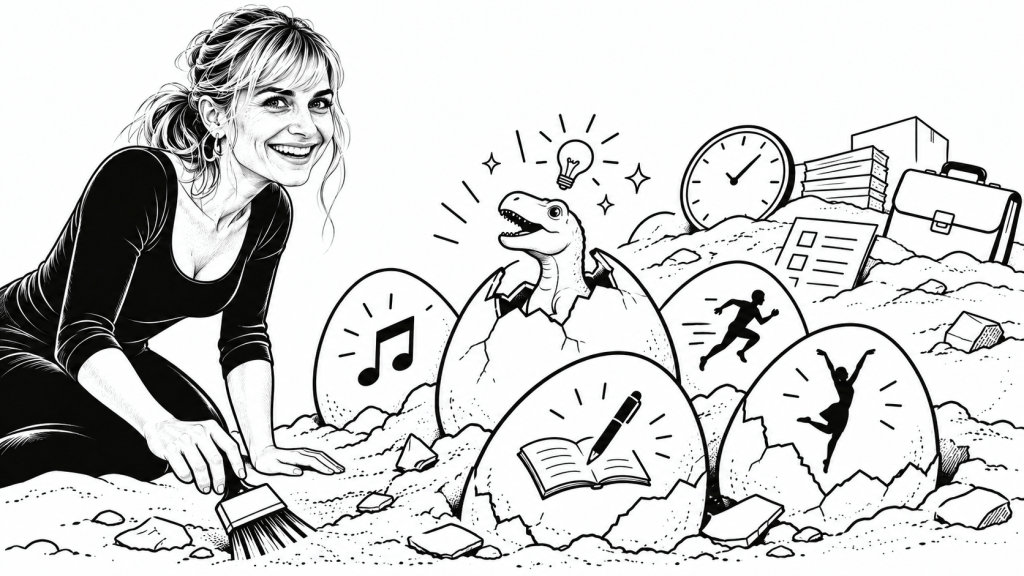
I sometimes imagine human potential as an enormous prehistoric nesting ground, with countless dinosaur eggs buried beneath layer after layer of sand. Inside every egg lies some extraordinary possibility: an artistic vision, a scientific discovery, an unconventional skill, an ingenious invention or perhaps an entirely new discipline that nobody has yet thought to name. But the sand keeps accumulating as life progresses. A mortgage, another deadline, another promotion, another obligation, another tiresome meeting, another decade devoted to satisfying expectations that were never entirely our own. Eventually, the surface becomes so firmly packed that we stop imagining anything might be hiding underneath it. We become accomplished at maintaining the landscape exactly as it is, diligently shovelling more sand onto the very possibilities we might once have explored.
And what a strange tragedy that would be: a world filled with magnificent creatures that never hatch, not because they lack the potential to flourish, but because the conditions required for their emergence never materialise. How many people possess remarkable abilities that will remain undiscovered throughout their entire lives? How many brilliant minds are occupied with repetitive tasks that leave them too exhausted to explore their own curiosity? And how many of us have become so accustomed to our prescribed roles that we no longer even suspect there might be something extraordinary buried beneath them?
My First Act of Rebellion: Reclaiming One Working Day
My own transformation didn’t begin with one enormous, dramatic decision. There was no cinematic moment when I marched into my workplace, threw my resignation across the desk and rode into the sunset on a white horse. I began reclaiming my freedom much more modestly, by reducing my working week from five days to four. On paper, the change might appear insignificant, but after years of working within a highly structured and emotionally demanding environment, one additional day of autonomy felt like one extra day of breating space. I had more time to recover, recharge my battery, to pursue my interests, explore new ideas and experience a day that wasn’t already organised around somebody else’s expectations.
For approximately a decade, I worked as a teacher in a secure educational setting with young people experiencing significant social, emotional and mental health difficulties. I cared deeply about those students, and teaching them could be exceptionally rewarding. Many had experienced considerable adversity, and building trusting relationships with them required patience, emotional sensitivity, creativity and the ability to recognise possibilities that other people might have overlooked. I don’t regret that chapter of my life, nor do I consider my professional efforts wasted. Working with vulnerable young people taught me an enormous amount about human behaviour, resilience, attachement and trauma. Nevertheless, the work was frequently intense, unpredictable and psychologically demanding in ways that are difficult to appreciate unless you have experienced a similar environment.
A seemingly ordinary school day could change dramatically within minutes. Some of the young people struggled with serious self-harming behaviours, and incidents could involve tying ligatures, swallowing dangerous objects, damaging property or behaving in ways that placed themselves or others at risk. Such situations required immediate professional de-escalation, safeguarding procedures and difficult decisions under pressure. And once the immediate danger had passed, another demanding stage began: documentation. I might have to remain at work completing lengthy incident reports, reconstructing exactly what had happened, describing the de-escalation techniques used, recording relevant observations and explaining the sequence of events in considerable detail. This paperwork was necessary because the incidents were serious and the young people’s safety mattered enormously, but it also meant that an already stressful day could extend well beyond the hours I was officially supposed to be working.
More importantly, the incident didn’t necessarily end when I completed the report or finally went home. I could find myself mentally replaying the entire situation, thinking about the young person who had tied a ligature, the incident involving a swallowed object, the decisions taken to protect somebody from harm or the possibility of another emergency the following day. Had everything been handled correctly? Could something have been done differently? Was the young person going to be safe? These were not the sorts of questions you could necessarily dismiss simply by closing a classroom door. My professional responsibilities might have officially ended, but my mind was still processing events that carried considerable emotional weight.
On top of this were the ordinary institutional requirements: meetings, training sessions, procedures, changing expectations, documentation and the inevitable complexities of workplace relationships. Some of these requirements were essential, particularly in a safeguarding environment, but their combined effect could leave very little psychological energy available for anything else. I began recognising that my exhaustion wasn’t simply the consequence of working a particular number of hours. It was also the result of how much attention my work continued to occupy after I had left the building. My body might be sitting comfortably at home, but my mind was still involved in an incident, a professional decision, a difficult conversation or an anticipated problem. I wasn’t merely surrendering my working hours to my profession; I was allowing it to occupy a substantial portion of my private mental world as well. And headspace, I would eventually discover, is one of the most precious resources a creative person possesses.
India: When One Month Wasn’t Enough
Another important stage in my transformation came through travelling to India, where I initially intended to spend one month. Once there, however, I became deeply absorbed in yoga, pranayama, meditation, philosophy and the extraordinary pleasure of learning without constantly worrying about the familiar obligations waiting for me elsewhere. My curiosity was growing rather than diminishing, and I realised that the original arrangement no longer suited what I wanted to experience. Instead of treating my itinerary as an unbreakable contract, I decided to extend my stay to two months. It was not an easy and straightforward decision, but it represented something important: I was beginning to organise my life around genuine curiosity rather than treating curiosity as an occasional luxury to be squeezed into the remaining spaces of an already crowded calendar.
There was something wonderfully liberating about spending hours exploring breathing techniques, bodily awareness, philosophical ideas and movement simply because I found them fascinating. I wasn’t required to explain how these activities would improve my annual performance review, increase my market value or provide another respectable certificate to display on LinkedIn. I could become completely absorbed in a subject without calculating its commercial usefulness, and that experience challenged some of the assumptions I had previously accepted about education and personal development.
We are frequently encouraged to learn in order to achieve something externally recognisable: a qualification, a promotion, a higher salary or an impressive professional identity. Yet learning can also be an intensely pleasurable activity in itself, expanding our understanding of the world and our experience of being alive. Imagine devoting two months to an interest simply because it makes your mind sparkle with curiosity. What a scandalously unproductive thing to do by conventional standards!
Finland: Ten Days Without the Noise
Another memorable experience took place in Finland, where I attended a ten-day Vipassana meditation course in a forest surrounded by thick snow. Ten-day meditation course with roughly ten hours of meditation each day interspersed with rest and vegetarian meals. The setting resembled a winter wonderland. There was silence, meditation, sel-fobservation and an extraordinary amount of time alone with my own mind. The absence of familiar stimulation created a completely different relationship with attention, encouraging me to notice sensations, thoughts and emotional reactions that might otherwise have disappeared beneath the demands of ordinary life.
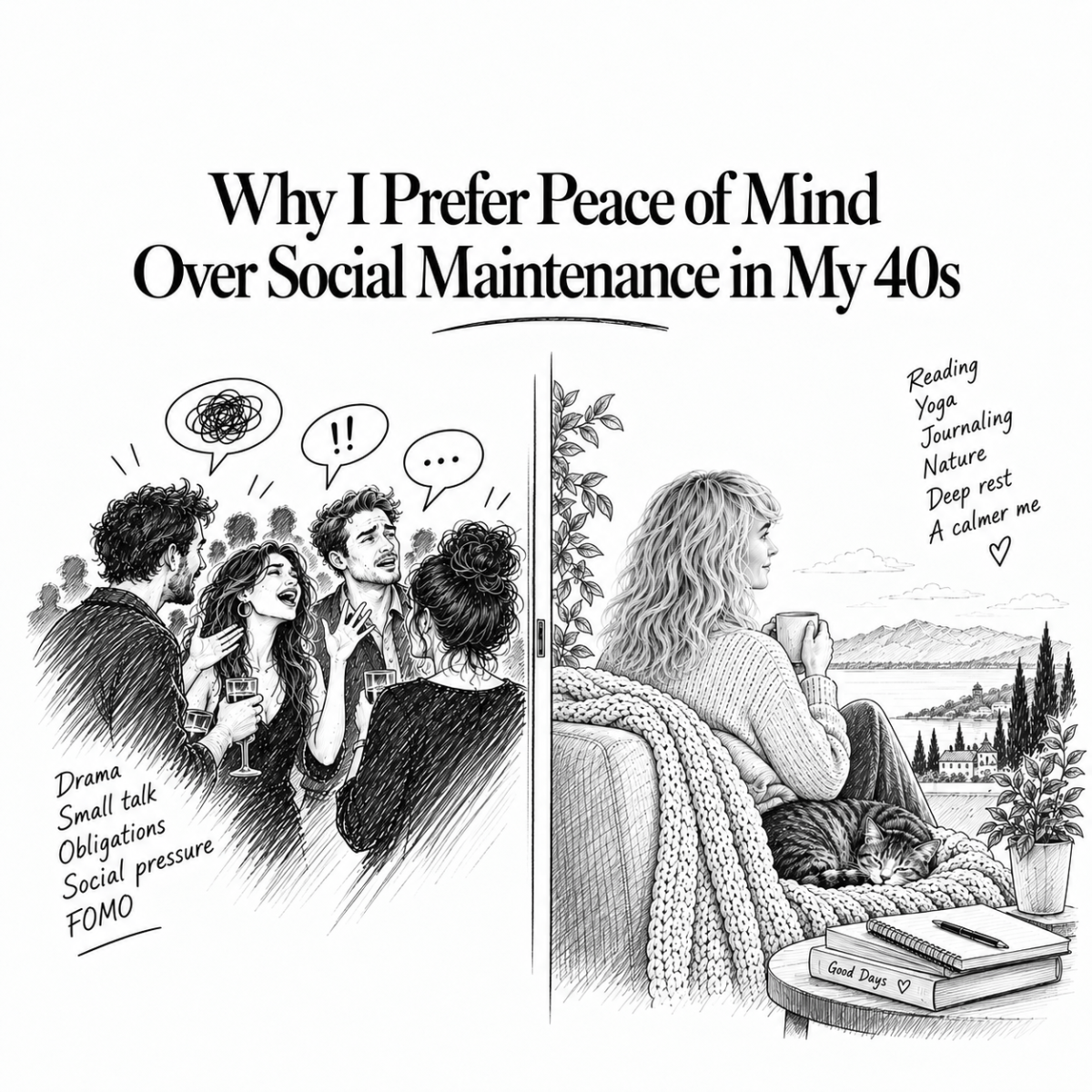
I wouldn’t romanticise intensive meditation as a magical solution to every human difficulty. Silence can be challenging, prolonged meditation can be uncomfortable, and not everyone experiences such retreats in the same way. But for me, the experience reinforced the value of uninterrupted attention and the extent to which our internal worlds can remain unexplored when we spend most of our waking hours responding to external demands. Without the usual flood of interruptions, I became increasingly interested in observing how my mind worked, what captured its attention and how much of my experience ordinarily went unnoticed. The retreat was another opportunity to loosen the hold of familiar routines and discover that being alone with my thoughts could be a rich experience rather than an empty space requiring immediate entertainment.
When My Old Identity Began to Feel Too Small
Eventually, I reached a point when the identity I had built around my professional life began to feel increasingly restrictive. It wasn’t that I suddenly disliked teaching or wanted to reject everything associated with my previous career. I had invested years in education, developed valuable skills and worked with young people whose experiences had profoundly influenced my understanding of human nature. That part of my identity remained meaningful, but it no longer seemed large enough to accommodate the person I was becoming. My curiosity, ambitions and interests were expanding, while the familiar structures of everyday life remained largely unchanged. It was rather like wearing a coat that had once fitted perfectly but had gradually become too tight. Other people might still admire the coat and insist that it suited me beautifully, but I could feel the seams straining whenever I tried to move.
I had also become increasingly tired of the relentless repetition. The same journey, the same building, the same professional expectations and the same routines continued week after week, until life began to resemble Groundhog Day. Unlike the character in the film, however, I wasn’t interested in repeating the same Wednesday until I finally mastered every detail of it. I wanted different Wednesdays altogether! Wednesdays filled with unfamiliar places, unexpected discoveries, fascinating ideas and experiences that had nothing to do with the roles I had spent years performing. I began to understand that familiarity and security, however valuable, could also become limiting when they left insufficient room for personal growth. I didn’t necessarily need to abandon everything I had achieved, but I did need to create space for possibilities I hadn’t yet explored.
Eventually, I resigned from my job and spent eight months travelling around Southeast Asia. It was an opportunity to expand beyond an identity that had become too narrow. During those months, I experienced different cultures, encountered new environments, observed people, reflected on my experiences and enjoyed the freedom to decide how I wanted to spend my time. The journey offered something more valuable than an impressive collection of destinations. It allowed me to experience myself without the familiar professional framework that had organised so much of my adult life, and to investigate interests that might never have received sufficient attention had I continued repeating the same routines indefinitely.
When you’ve spent years performing a particular role, other people develop expectations about who you are, how you should behave and what constitutes an appropriate use of your time. Gradually, you can begin confusing those expectations with your actual personality. Removing yourself from the familiar environment can make those assumptions surprisingly visible. You begin asking what genuinely interests you when nobody is directing your attention, what activities energise you, which obligations you have accepted without questioning them, and which parts of yourself may have remained dormant because they didn’t fit comfortably within the life you had constructed. My travels encouraged me to recognise that freedom wasn’t merely about having more leisure time or visiting unfamiliar places. It was also about recovering the ability to decide which parts of myself I wanted to develop.
Coming Home Without Returning to the Old Life
Eventually, I returned to England and continued teaching English online as a self-employed tutor. This is where my experience becomes particularly interesting, because it challenges the simplistic assumption that creativity automatically increases when we work fewer hours. I still work hard, and some weeks I teach approximately 36 hours. Yet the psychological experience of my working life has changed enormously. When I finish my online lessons, I am generally not carrying the same emotional burden that accompanied my previous employment, nor am I required to navigate the same institutional structures, workplace relationships and unpredictable, stressful responsibilities. I can complete my teaching, close my laptop and move into another part of my life with considerably more attention available for my own interests.
Online teaching still requires concentration, preparation, patience and the ability to respond to students’ individual needs. After several consecutive lessons, I can certainly feel tired, and I have no intention of pretending that self-employment is a peaceful realm in which every working day consists of sipping coffee while admiring one’s flexibility. There are administrative tasks, scheduling problems, financial uncertainties and occasional frustrations, just as there are in most occupations. But the nature of the mental effort is different. I am no longer returning home after a frightening safeguarding incident and replaying the entire sequence of events, or carrying the responsibility of documenting serious situations involving vulnerable young people. Nor am I obliged to participate in the same degree of institutional theatre, with its endless procedures, compulsory meetings, organisational politics and subtle expectations about how one should behave within a particular professional culture.
The distinction is fundamental: I may be working approximately the same number of hours, but I have considerably more psychological freedom. We often measure the demands of employment through hours worked, salary received and annual leave entitlement, as though two jobs requiring the same amount of time must impose comparable burdens. Yet the emotional and cognitive costs can be radically different. One working environment may leave somebody completely drained by constant interruptions, social performance, unpredictable emergencies and serious responsibilities, while another allows that same person to work productively and finish the day with enough mental energy to pursue an entirely separate creative life. I began discovering that my problem hadn’t necessarily been the amount of time I spent working, but the proportion of my mental resources that work consumed. Once that burden diminished, I found myself with something I had been missing for years: the freedom to think about subjects that belonged entirely to me.
The Creative Explosion: Discovering the Creatures Beneath the Sand
As my life gradually became less dominated by institutional demands and familiar routines, I began noticing something extraordinary. My imagination seemed to be expanding, my curiosity became increasingly difficult to satisfy, and my awareness of everyday experiences felt more vivid. I found myself paying closer attention to music, movement, interesting conversations, philosophical questions, bodily sensations and the countless possibilities concealed within apparently ordinary activities. Whether these changes resulted from greater freedom, more headspace, mindfulness, some combination of all three is difficult to determine. What I do know is that the more room I created for personal exploration, the more ideas began competing for my attention. And unlike the paperwork that had previously competed for it, these were ideas I actually wanted to investigate!
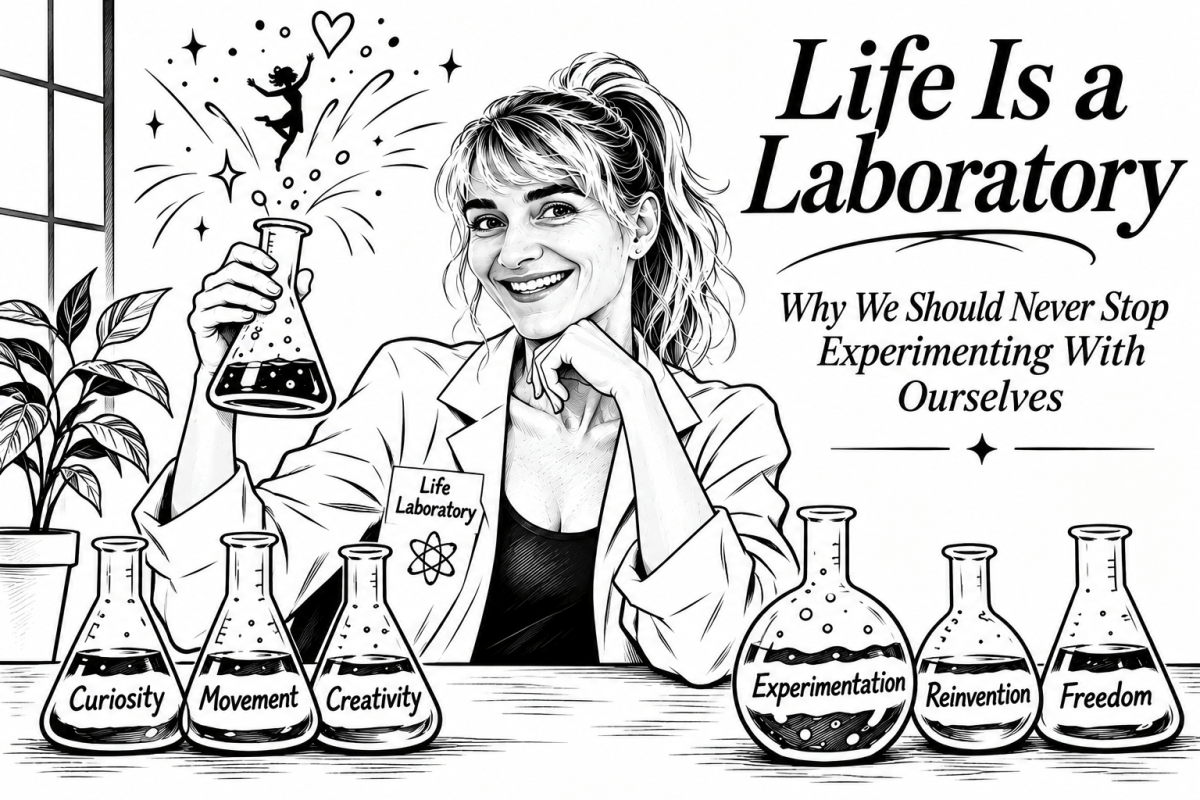
One of the most significant developments was Eccentricize, my personal philosophical laboratory devoted to individuality, experimentation, freedom, unconventional living and the sheer absurdity of being human. Writing became a way of exploring questions that had fascinated me for years, challenging familiar assumptions and developing my own philosophy of life. Rather than simply consuming other people’s ideas, I began creating a growing body of work that reflected my own observations, experiences and intellectual interests. I also returned to composing my own tunes, something I had experimented with long before my recent transformation but had not always given the sustained attention it deserved. Music offered another language through which I could express feelings and ideas that didn’t necessarily fit comfortably into ordinary words, and I began appreciating how many creative possibilities could emerge when I stopped treating my interests as occasional diversions from more respectable activities.
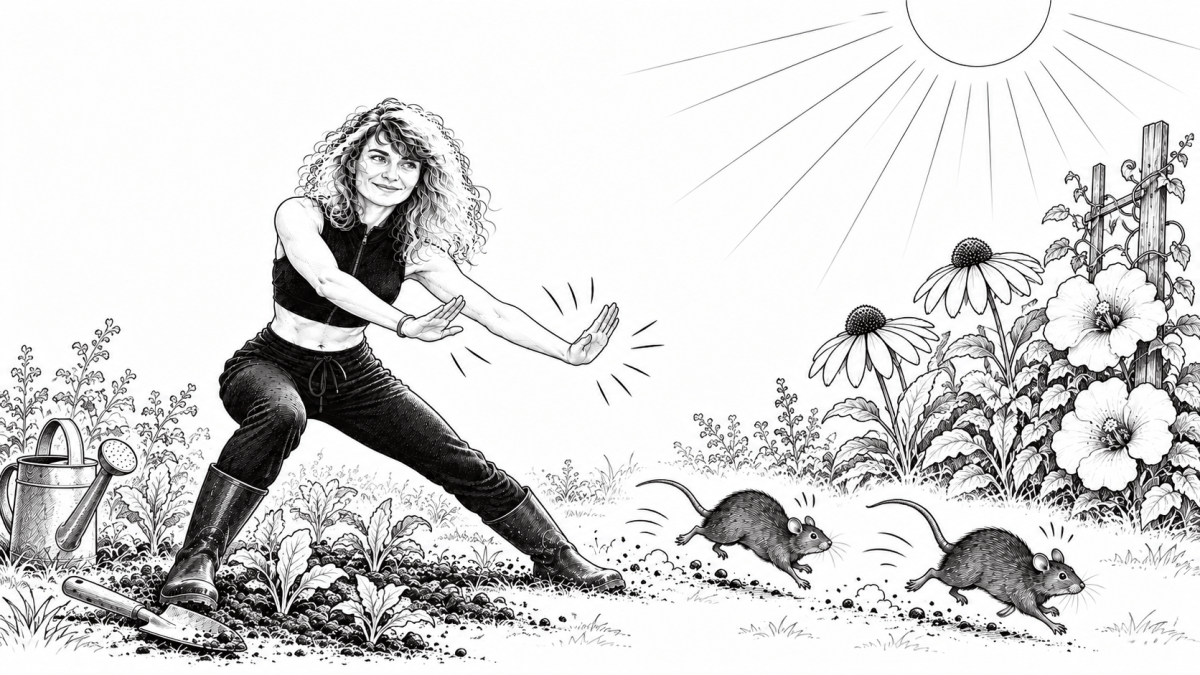
Running also developed into a major part of my life, bringing together physical experimentation, discipline, discovery and immense joy. I became increasingly interested in what my body could accomplish and began pursuing more ambitious challenges, including marathon training. But perhaps the most outrageous creature to emerge from my prehistoric nesting ground was Outlanga, my own expressive movement practice. Imagine ballet entering into a playful relationship with tai chi, belly dancing, core exercises, stretching, skipping, jumping and spontaneous prancing. Outlanga developed through my fascination with movement, music, bodily awareness and the freedom to experiment without asking whether every movement belonged to an established discipline. Sometimes I dance, sometimes I stretch, sometimes I leap, balance, sway, twist or invent combinations that probably don’t have names yet, and I find the entire process enormously exhilarating.
What makes Outlanga particularly meaningful is that I created it without waiting for anybody to authorise its existence. I simply began experimenting and allowed the practice to evolve. It represents the pleasure of creating something original without first requiring reassurance that it fits an existing category. The same principle increasingly informs my writing, music and broader approach to life: I want to investigate possibilities because they fascinate me, rather than restrict myself to activities that other people already understand or approve of.
And this brings me back to those dinosaur eggs buried beneath the sand. I don’t think the writer, dancer, composer or philosopher suddenly appeared inside me when I changed my working arrangements. Many of these interests had been lying in me dormant quietly for years, sometimes receiving a tiny bit of attention and sometimes being buried deeper beneath the obligations of everyday life. What changed was my ability to explore them with greater curiosity, openness, consistency, enthusiasm and independence. My experience has made me wonder how many people possess similarly rich collections of interests and potential abilities that remain largely unexplored because their circumstances leave them without the energy, encouragement or freedom to investigate them. Perhaps what we casually describe as a lack of talent is sometimes a lack of opportunity to discover talent in the first place.
The Myth That Everyone Has the Same Opportunity
At this point, I must acknowledge an important objection. Not everyone can afford to reduce their working hours, resign from a job, travel for months or reorganise their professional life. Many people are raising children, supporting relatives, managing financial insecurity or working several jobs simply to keep their households functioning. Others have health difficulties, caring responsibilities or circumstances that restrict the choices available to them. Advising such people to abandon their obligations and pursue their passions would be both unrealistic and insulting. Freedom is not distributed equally, and personal courage alone cannot overcome every economic or social obstacle. My own experiences were made possible partly by decisions I took, but also by the resources, circumstances and opportunities that allowed me to take them.
And that is precisely why I believe this subject deserves to be considered as a social question rather than merely a matter of individual lifestyle choices. If developing human potential requires time, security, educational resources, encouragement and psychological freedom, then the way we organise work, education and society directly influences how much potential can realistically emerge. Consider someone who works exhausting shifts, spends hours commuting and worries constantly about paying rent. Perhaps that person possesses an exceptional aptitude for mathematics, a remarkable musical imagination or an extraordinary talent for invention. But discovering and developing such abilities usually requires opportunities to encounter new subjects, experiment without immediate consequences, acquire knowledge and persevere through repeated failures. If nearly every available resource is consumed by survival, the talent may never receive enough attention to become visible.
Christopher Havens’s story becomes particularly compelling when examined from this perspective. His mathematical abilities emerged through a combination of personal determination, educational materials, mentorship and sustained engagement with an unfamiliar intellectual discipline. Imprisonment was not the essential ingredient, and it would be absurd to suggest that people need total isolation in order to flourish. His experience demonstrates something more important: abilities can emerge in unexpected circumstances when a person encounters a subject that captures their imagination and receives enough time, resources and support to pursue it. What might have happened if Havens had discovered mathematics earlier, before the destructive circumstances of his life led to imprisonment? Nobody can answer that question, but it should encourage us to consider how many other people never receive a comparable opportunity for intellectual discovery.
There is also a widespread tendency to treat creativity as an optional luxury, something to be enjoyed after the serious business of earning money and fulfilling obligations has been completed. Yet creativity is not confined to painting pictures, composing symphonies or writing novels. It contributes to scientific discoveries, technological innovations, practical problem-solving, social improvements and the development of entirely new ways of thinking. A society that leaves large numbers of people without the time or opportunity to cultivate their abilities may therefore be sacrificing far more than individual happiness. It may be depriving itself of discoveries, inventions, perspectives and solutions that could benefit everyone. The tragedy is that we rarely recognise such losses because the unrealised possibilities remain invisible. We can calculate the cost of wasted materials, lost productivity or unused buildings, but how can we measure the value of a brilliant idea that nobody was ever given the opportunity to develop?
Uniformity: The Great Enemy of Human Possibility
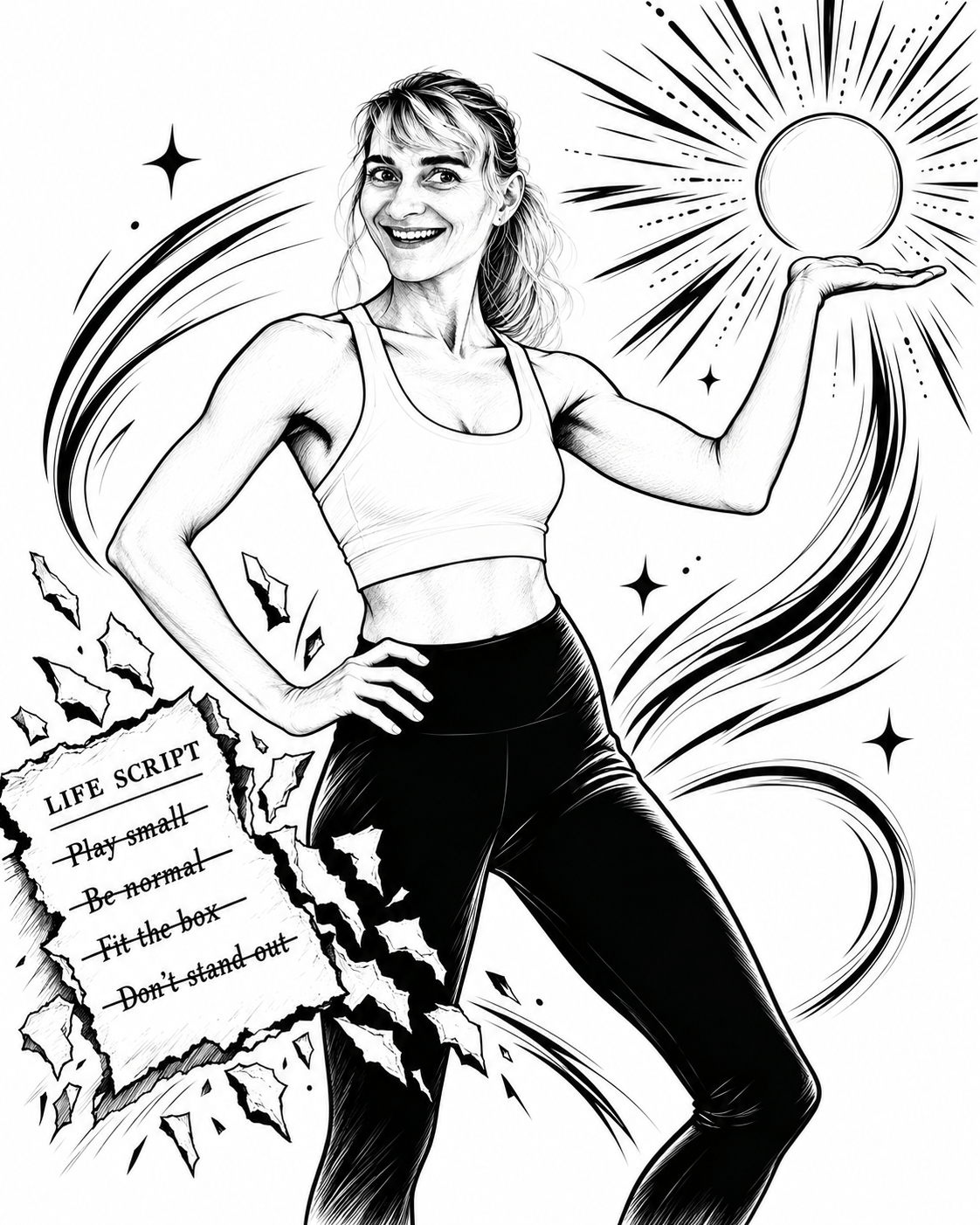
One of my greatest objections to modern society is its extraordinary enthusiasm for squeezing diverse human beings into remarkably similar roles. From childhood onwards, we are encouraged to follow familiar routes, achieve recognisable qualifications, establish respectable careers, conform to conventional expectations and organise our lives around milestones that other people have already decided are desirable. Attend school, obtain qualifications, find employment, establish a household, fulfil your responsibilities and avoid doing anything that might make the neighbours question your sanity. There is nothing inherently wrong with any of these choices, and many people find genuine fulfilment in following them. The problem arises when one version of a successful life becomes so culturally dominant that alternatives are treated as irresponsible, immature, eccentric or somehow wrong.
Human beings differ enormously in temperament, abilities, interests, values and aspirations. Some people thrive in structured environments, while others require considerable independence. Some are exceptional organisers, others imaginative inventors. Some think primarily through numbers, others through images, language, sounds, movements or physical experimentation. Some find deep fulfilment in family life and familiar routines, while others flourish through solitude, intellectual exploration, travel, creative work or unconventional combinations of interests. Why should we expect such a diverse species to find satisfaction inside the same narrow collection of social moulds? And why do we so readily assume that those who resist conventional expectations are somehow failing to understand how life is supposed to work, rather than considering that they might have discovered a different way of organising it?
I sometimes imagine society as an enormous orchestra containing every musical instrument ever invented, along with a few peculiar instruments that nobody has managed to identify. Instead of encouraging the musicians to explore their distinctive sounds, however, the conductor insists that everyone must play the same three notes, at the same tempo, using identical techniques. The violinists must abandon their expressive possibilities, the percussionists must stop experimenting with rhythm, and the saxophonists are politely informed that their enthusiasm is becoming disruptive. The result might be wonderfully orderly, but surely the musical possibilities would be appallingly limited. We would have sacrificed nearly everything that makes an orchestra interesting in the pursuit of uniformity, and then congratulated ourselves on achieving harmony.
This is one of the reasons I consider eccentricity so valuable. Eccentric people are not automatically wiser, more creative or more talented than conventional people, but they may be more willing to experiment with possibilities that others dismiss without investigation. Their interests can challenge assumptions, introduce unfamiliar perspectives and encourage others to question established ways of doing things. An unconventional idea may turn out to be utterly ridiculous, of course, but it may also become the beginning of something truly transformative. Progress requires the freedom to distinguish between those possibilities through exploration, rather than rejecting unusual ideas simply because they don’t resemble what already exists. If originality is consistently discouraged, we shouldn’t be surprised when originality becomes scarce.
Why Pluralism Is Essential for Progress
This brings me to the importance of pluralism, a principle that I believe deserves far more attention in discussions about human potential and social progress. Pluralism goes beyond merely tolerating people who differ from us. At its most valuable, it recognises that diversity of knowledge, experience, temperament, belief and ability can make a community more resourceful, imaginative and capable of responding to complex challenges. A society composed entirely of people who think alike might appear wonderfully harmonious, particularly to those who dislike disagreement, but its members could also share the same blind spots. When an unfamiliar problem arises, they may struggle to recognise solutions that fall outside their established patterns of thought.
Now imagine a society in which people have been encouraged to develop their distinctive abilities and pursue different intellectual interests. Mathematicians, artists, engineers, philosophers, scientists, teachers, craftspeople, musicians, historians, unconventional thinkers and people with unusual combinations of knowledge all approach the world from different perspectives. One person notices a mathematical pattern that another overlooks, while somebody with artistic training identifies a visual relationship that specialists in another field had failed to recognise. A practical problem encountered by a craftsperson inspires an engineer, an unfamiliar cultural perspective helps a researcher reconsider an assumption, or a philosophical question exposes a limitation in an apparently successful technological solution. The value of such exchanges lies not simply in the presence of difference, but in the opportunity for different forms of knowledge to interact and complement one another.
Diversity does not automatically guarantee creativity, cooperation or better decisions. People with different perspectives may misunderstand one another, struggle to communicate or become trapped in unproductive disagreements. For pluralism to generate meaningful benefits, individuals need the freedom to express their ideas, the willingness to listen and the opportunity to combine their strengths. Nevertheless, a society that encourages a broad range of intellectual and practical abilities possesses more possibilities than one that systematically pressures everybody to adopt identical priorities and approaches. We cannot predict which unusual interest might become relevant to a future discovery, or which apparently unrelated field might provide the insight needed to solve an unexpected problem. That uncertainty is precisely why preserving intellectual variety is so important.
There is an interesting parallel here with evolution. Biological evolution depends on heritable variation, with natural selection and other processes influencing which characteristics become more common over time. Human cultural and intellectual development operates differently, but variation remains a useful analogy. A population containing a broader range of ideas, skills and approaches has more potential responses available when circumstances change. If we insist that everyone think alike, learn alike and pursue the same limited definitions of success, we restrict the possibilities that can be explored. Uniformity may simplify administration and make human behaviour easier to predict, but it can also deprive us of the unexpected connections and unconventional experiments through which new knowledge emerges.
For me, this is one of the strongest arguments for encouraging individuality rather than merely permitting it reluctantly. We don’t need every person to become a mathematician, a musician, an entrepreneur or an artist. Nor do we need everyone to abandon conventional employment and spend their afternoons inventing new dance disciplines in their living rooms, although I must admit that the prospect of a society filled with spontaneous Outlanga practitioners is rather appealing. What we need is a culture in which different interests and abilities can develop without being automatically dismissed as impractical, strange or socially undesirable. A person whose mind thrives on mathematics should have opportunities to explore mathematics, just as someone captivated by movement, music, philosophy or craftsmanship should be encouraged to develop those interests. When people cultivate different strengths, they expand not only their own possibilities but also the collective resources available to humanity.
How Much Human Genius Are We Throwing Away?
Whenever I reflect on Christopher Havens’s mathematical journey and my own gradual transformation, I return to the same unsettling question: how much potential remains hidden because people are too occupied with surviving, conforming or performing familiar roles to investigate what else they might become? We can identify the mathematicians who publish discoveries, the writers who complete remarkable books and the inventors whose ideas transform everyday life. Their achievements become visible, measurable and sometimes celebrated. But we cannot identify the countless people who might have accomplished something extraordinary under different circumstances, because their potential never developed far enough to be recognised. An undiscovered talent leaves no scientific paper, no musical composition, no invention and no record of the possibilities that disappeared with it.
I find this particularly troubling because society often equates human value with established achievements and recognisable professional identities. We admire exceptional scientists, celebrated artists and successful entrepreneurs, but we devote comparatively little attention to the conditions that allow such people to emerge in the first place. Talent is not always obvious during childhood, nor does it necessarily reveal itself through conventional educational assessments. Some abilities develop late, some require unusual experiences to become visible, and others emerge only when a person encounters a subject that captures their imagination with sufficient intensity. Havens didn’t follow the conventional route from academic success at school to university mathematics. His discovery occurred under circumstances that nobody would reasonably recommend, and yet it transformed his intellectual life. How many other unexpected transformations might become possible if people had more opportunities to explore unfamiliar fields before deciding that their abilities had already been fully established?
My own story is far less dramatic, but it has convinced me that the relationship between freedom and creativity deserves serious attention. I still teach, work hard and fulfil responsibilities, but I have gradually removed many of the conditions that previously consumed my mental energy. In doing so, I have discovered a much richer collection of interests than the ones that once dominated my everyday life. Writing, music, running, philosophical reflection and Outlanga have become meaningful parts of my identity, not because I suddenly acquired an entirely new personality, but because I finally created enough space to explore aspects of myself that had previously received insufficient attention. I can’t help wondering how many other people might experience similar discoveries if their lives allowed them more psychological freedom, more opportunity for experimentation and less pressure to remain permanently inside their established roles.
There is an important distinction between encouraging people to develop their potential and demanding that they turn every interest into another achievement. I have no desire to replace the exhausting pressures of conventional productivity with an equally oppressive requirement to become a brilliant inventor, celebrated artist or millionaire entrepreneur in one’s spare time. Human beings should be free to explore activities for their intrinsic pleasure, without feeling obliged to justify every hour through commercial success or public recognition. A person who discovers a love of painting at sixty, learns to play an instrument simply for enjoyment or begins studying philosophy without intending to publish anything has not wasted their time. The discovery itself can enrich their life, expand their understanding and bring them into contact with experiences that would otherwise have remained unavailable. Human potential is not valuable only when it produces something that can be sold.
And perhaps that is the deepest problem with a culture that defines success through a narrow range of socially approved outcomes. It encourages us to overlook the enormous variety of ways in which human beings can develop, contribute, create and experience fulfilment. We become so preoccupied with placing people into useful categories that we forget to ask what might happen if they were given more room to explore beyond them. We assume the accountant should remain an accountant, the teacher should remain a teacher and the person who has spent twenty years following a particular routine should continue doing so indefinitely, as though adulthood were a process of gradually reducing our possibilities until only one acceptable version of ourselves remains. Yet personal development need not stop when we establish a career or reach a particular age. Our interests can change, our abilities can evolve, and entirely new dimensions of our personalities can emerge when circumstances allow us to investigate them.
Let the Dinosaurs Hatch!
I didn’t dismantle my daily grind overnight. I chipped away at it slowly, patiently and sometimes experimentally, removing one piece after another as my understanding of what I wanted from life continued to evolve. One working day reclaimed from the calendar, one journey extended because curiosity demanded more time, ten days of silence in a Finnish forest, eight months exploring Southeast Asia and eventually a different arrangement for earning a living. None of these experiences suddenly transformed me into an entirely different person, but together they loosened the grip of routines and expectations that had previously occupied so much of my attention. As that grip weakened, I began discovering interests, abilities and ambitions that had been developing quietly beneath the surface for years. The writer, dancer, composer, runner, philosopher and creator of Outlanga weren’t necessarily strangers who appeared out of nowhere; they may simply have been waiting for enough room to emerge.
That is why Christopher Havens’s experience continues to fascinate me. His story is not a celebration of imprisonment, nor proof that suffering automatically produces greatness. It is a reminder that intellectual abilities can remain undiscovered until curiosity encounters opportunity, encouragement and the conditions necessary for sustained exploration. If a man with such an unconventional educational history could discover an unexpected aptitude for advanced mathematics, what might countless other people be capable of developing if they were given the chance? How many gifted individuals are too exhausted after work to discover what genuinely fascinates them? How many unconventional thinkers have learned to distrust their own ideas because society repeatedly rewards obedience and predictability? How many original creations have never been brought into existence because their potential creators were too busy fulfilling obligations or trying to become the people everyone else expected them to be?
Perhaps one of the greatest forms of waste in human society is not the careless disposal of materials, the inefficient use of energy or even the squandering of money, but the immense quantity of human potential that never receives an opportunity to develop. We cannot calculate its full extent, because we cannot count the discoveries that were never made, the books that were never written, the music that was never composed or the extraordinary combinations of skills and insights that never emerged. Yet the absence of measurable evidence doesn’t mean the loss is insignificant. When we encourage conformity at the expense of originality, restrict opportunities for exploration and treat individuality as something to be corrected rather than cultivated, we may be sacrificing possibilities that would have enriched not only individual lives but society as a whole.
I believe humanity would benefit enormously from replacing its obsession with rigid roles and prescribed moulds with a more pluralistic understanding of human potential. We don’t need everyone to think alike, aspire to identical achievements or follow the same definition of a successful life. We need people with different abilities, experiences, interests and ways of understanding the world, because those differences allow us to complement one another and approach unfamiliar problems from perspectives that no single individual could possess. Uniformity may make society easier to organise, but pluralism gives it a richer collection of possibilities for discovery, adaptation and advancement. A civilisation that encourages originality and experimentation is better positioned to benefit from the extraordinary variety of human minds than one that continually pressures people to suppress whatever makes them unusual.
And so I return to my prehistoric nesting ground, where millions of extraordinary possibilities may still be lying dormant beneath the accumulated sand of conformity, obligations and unexamined expectations. Some of those eggs might contain remarkable intellectual abilities, some astonishing artistic talents, and others entirely unfamiliar combinations of interests that could lead to discoveries nobody has yet imagined. Not every egg will produce a spectacular dinosaur, of course, and there is no reason why every human being must become exceptional in order to live a meaningful life. But surely we should be deeply concerned about a society in which so many possibilities never receive the conditions necessary to develop at all. Rather than continually shovelling more sand onto people’s curiosity, perhaps we should be helping them uncover what lies beneath it, creating more opportunities for education, experimentation, independence and genuine self-discovery.
How many geniuses have lived and died without ever discovering they were geniuses? How many magnificent dinosaurs will remain buried forever because we insisted on turning everyone into the same perfectly respectable, obedient and predictable creature? And what extraordinary things might humanity accomplish if, instead of squeezing people into ever narrower moulds, we finally gave their individuality enough freedom to flourish?




Leave a Reply