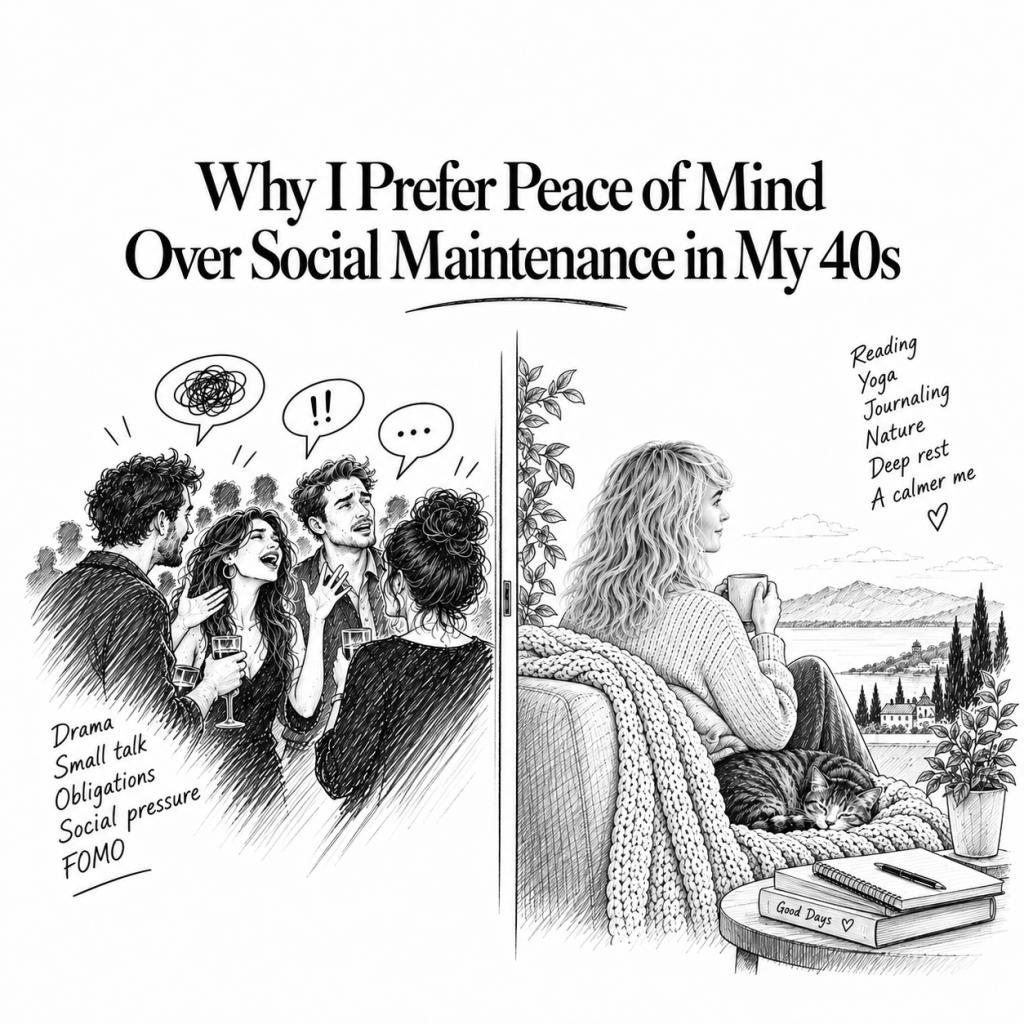
For a long time, I thought I had a problem with building and maintaining social connections. My social network was never especially strong, and I used to assume this meant I needed to try harder: go out more, put myself out there, make friends, date, join MeetUp groups, be more sociable, be more outgoing and sociable. Over time, though, I began to wonder whether the problem was not connection itself, but the way so much connection seemed to happen. What exhausted me was not simply being around people. It was the kind of conversations that seemed to dominate: complaints about everything from boss and co-workers to the weather, gossip, grumpiness, interpersonal drama, endless analysis of who said what, who felt slighted, who was rude, who failed to reply, who grouped with whom, who disappointed whom. So much emotional energy seemed to go into things that could not be changed, would not be changed, or were simply being revisited again and again.
At some point, I realised that I had become far more interested in a completely different kind of conversation. I wanted to hear about dreams, goals, plans, ideas, travels, experiments, discoveries, things people were learning and what made them genuinely excited to wake up in the morning. I wanted to know what someone secretly wanted to try, what they were building, what had surprised them about themselves, what they hoped their life might look like in five years, what made them lose track of time and build momentum, and what made them feel thrilled to be alive. Those conversations feel expansive to me. They point somewhere. They make life feel larger.
I Want to Know What Makes You Feel Alive
What fascinates me is how rarely adults seem to talk this way. We can spend extraordinary amounts of time discussing frustrations, inconveniences, other people’s behaviour and the latest social drama, but conversations about dreams or happiness can suddenly feel almost embarrassing. Adults can talk for an hour about somebody behaving badly at work without anyone raising an eyebrow, but start talking earnestly about what you want to create, what gives your life meaning or what you are excited to become, and it can somehow sound naive, self-indulgent or juvenile.
I think that is backwards. Dreams and goals should not be dismissed as childish simply because they involve hope. Happiness should not be regarded as a fluffy subject. Exploration, self-discovery, creativity, reinvention and personal growth are not somehow less serious than office politics or relationship drama. These things shape how we actually use our lives. Surely they deserve adult attention.
The Strange Economy of Attention
A few months ago, I met up with a friend and found myself genuinely surprised by how little time we spent on the things I found fascinating. I had travelled for eight months, yet that part of the conversation was almost reduced to a checklist: Did you go to Indonesia? Did you go to the Philippines? She briefly mentioned a trip to Morocco, and then much more emotional energy went into dissecting a falling-out involving friends, a wedding, misunderstandings and the feeling of being abandoned when another friend clustered with a different group of women.
The conflict may have mattered to her, of course, and I am not saying difficult experiences are unworthy of attention. What struck me was the ratio. Huge, expansive experiences were brushed past, while social friction became the emotional centre of the conversation. I left feeling depleted. It made me realise just how differently I now want to spend my attention. I am increasingly uninterested in giving endless mental space to situations that are stagnant, circular or fundamentally outside our control. If we cannot change something, are unwilling to change it, or have already analysed it twenty times, at what point does talking about it stop helping and simply become another form of repetition?
I Used to Be Like This Too
This is not me pretending I have always floated above gossip and negativity in a cloud of philosophical purity. I used to participate in exactly that kind of conversation. I gossiped. I complained. I spoke negatively about other people and about myself. It was part of the relational culture I grew up around, and for a long time I simply did not know that there were other ways to connect. Criticism, complaint and dissecting people’s behaviour were normal forms of conversation to me because that was what I knew.
Only after gaining distance from that environment did I begin to notice how much of ordinary social interaction revolved around repetition rather than growth. I started discovering other kinds of conversations and, more importantly, other kinds of inner life. Once I experienced what it felt like to spend more time on curiosity, possibility, creativity, introspection and self-development, it became much harder to return to relationships built primarily around complaint and social drama.
My Mindset Changed Because I Changed
That shift did not happen overnight. It coincided with years of inner work: self-help and self-development books, journaling, gratitude, therapy, healing, reflecting on childhood patterns and doing inner-child work. I gradually became more conscious of which beliefs and conversational habits were actually mine and which ones I had simply absorbed. Books such as See You at the Top by Zig Ziglar, From Good to Amazing by Michael Serwa and Do Epic Shit by Ankur Warikoo formed part of that wider period of questioning how I wanted to think, what I wanted to give my attention to, and what kind of life I wanted to build.
The more inner work I did, the less satisfying certain conversations became. I began to notice how easily adults can spend hours analysing other people, replaying conflicts, complaining about circumstances they have no intention of changing, or talking themselves and other people down. At the same time, conversations about possibility, growth, dreams, happiness, creativity and self-discovery began to feel increasingly nourishing. They made me feel as though life was expanding rather than contracting.
I genuinely think we need to normalise those subjects. Talking about what excites you should not be dismissed as naive. Talking about goals should not be treated as childish wishful thinking. Asking what makes somebody happy should not feel less intellectually respectable than asking what is wrong with their workplace or relationship. There is nothing immature about taking your own aliveness seriously. In fact, perhaps adulthood would be healthier if more of us did.
Social Maintenance Can Become Time and Energy Consuming
There is a type of socialising that feels less like connection and more like maintenance. It is the repeated processing of old grievances, keeping track of social obligations, analysing other people’s behaviour, monitoring who is getting along with whom and maintaining an endless emotional spreadsheet of everyday relationships. For some people, that may feel natural and even comforting. It can create belonging and strengthen alliances. For me, too much of it feels like static.
I would rather spend an hour talking about a wild idea, a new skill, a strange book, a creative project, a life experiment, a trip or a question with no obvious answer than spend the same hour replaying a conflict that nobody intends to resolve. That is what I mean when I say I prefer aliveness over social maintenance. I do not mean that every conversation has to be relentlessly positive or motivational. I mean I increasingly want conversation to contain proactivity, assertiveness and problem-solving rather than endlessly recycling the same emotional material.
Not Every Difficult Conversation Is Pointless
Avoiding negative topics altogether would be superficial in a different way. Sometimes people need to talk through grief, betrayal, fear, anger, confusion or disappointment. Sometimes a difficult conversation creates clarity, and sometimes naming a problem is the first step toward changing it. I value those conversations when they are actually processing something.
The distinction, for me, is whether the conversation is going somewhere. Is it helping us understand something more clearly? Is it leading to a decision, a boundary, relief, perspective or change? Is somebody becoming more assertive, more proactive, more willing to solve the problem or accept what cannot be changed? Or are we simply circling the same grievance for the tenth time because repetition itself has become a form of bonding? The first can be deeply meaningful. The second often leaves me feeling as though enormous amounts of attention have been spent without anything actually transforming.
Maybe My Small Network Makes More Sense Than I Thought
For years, I sometimes looked at my small or at times nonexistent social network as evidence that I was missing something. Now I increasingly see it as a consequence of becoming much more selective about what feels nourishing. If most of the available forms of connection do not energise you, you are unlikely to pursue connection merely for the sake of having it. If you value peace, introspection, creativity and possibility, simply having people around is not automatically better than being alone.
That does not mean there are no wonderful people out there. Of course there are. Meaningful relationships can be extraordinary and very fulfilling. But finding a genuinely restorative connection can sometimes feel like separating the wheat from the chaff. The presence of another human being is not enough. The quality of attention matters. The spirit of the conversation matters. Compatibility matters. Whether you leave the interaction feeling better or worse matters.
Perhaps if more social interaction revolved around dreams, goals, happiness, exploration, creativity and self-discovery, my relationships would naturally be stronger. Maybe some people who appear highly solitary are not rejecting human connection at all; maybe they are rejecting forms of connection that feel repetitive, draining or emotionally disregulating.
Maybe Adult Conversations Need Different Questions
I think I want different questions now. Not only “Who annoyed you this week?” but “What has made you excited lately?” Not only “What went wrong?” but “What is beginning to go right?” Not only “What happened?” but “What are you trying to build?” Not only “Who said what?” but “What have you realised about yourself?”
I want adult conversations in which ambition is not embarrassing, joy is not trivial, dreams are not dismissed as fantasy and curiosity does not have to apologise for itself. I want to hear what makes somebody’s eyes light up, what they are learning, what they are experimenting with, what they hope to become and what makes them feel genuinely grateful to be here.
Until then, I will often choose reading, writing, walking, creating, learning, meditating or thinking over socialising that leaves me depleted. I no longer interpret that preference as evidence that something is missing. I think I have simply become more protective of my attention and more interested in what makes life feel alive. And perhaps that is the real shift: I have not given up on people. I have become less willing to maintain connection at the expense of peace of mind.








Leave a comment