Social Connection is not Everyone’s Ticket to Wellbeing
We are repeatedly told that human beings are social creatures, that connection is essential, that isolation is dangerous and that strong relationships are one of the main ingredients of a good life. There is truth in that at a population level. Supportive relationships can be meaningful, protective and deeply nourishing. But somewhere along the way, a useful general principle has hardened into something far more rigid: the assumption that everyone must actively seek social connection in order to be mentally healthy, fulfilled and happy. That is where I start to object.
The Social Pressure Starts With Something as Small as “What Are You Doing This Weekend?”
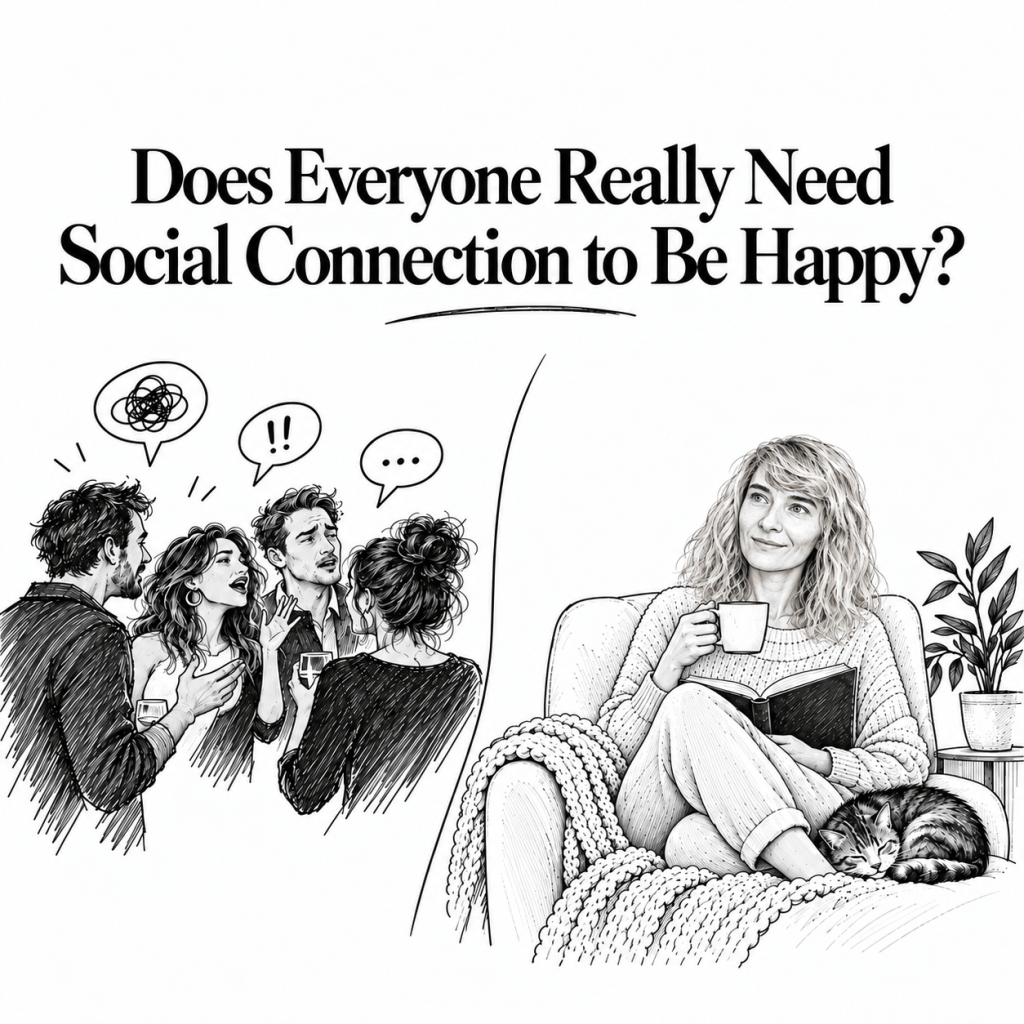
Imagine Friday afternoon at work. A colleague asks, “What are your plans for the weekend?” If you say, “I’m going out with friends, having drinks, dancing, maybe staying out until 2 a.m.,” the response is usually enthusiastic. Wonderful. Exciting. Fun. You have plans. You are living. Now imagine answering truthfully: “Nothing social, actually. I’m spending the weekend alone. I’m going to read, do yoga, meditate, journal, work on a side project and enjoy having absolutely nobody around.” The atmosphere changes. Suddenly there is that slight tilt of the head, that look of concern, sometimes pity, sometimes a well-meaning suggestion that you should “get out more.”
And yet the socially approved option may be objectively far more draining. A weekend of drinking, sleep disruption, noise, overstimulation and exhaustion can be celebrated as healthy fun, while a quiet weekend of movement, reading, reflection and creativity is treated as somehow tragic. We have become very good at confusing socially visible activity with wellbeing. If an activity involves other people, it is automatically upgraded. If it involves solitude, it is often treated as something that needs explaining.
Solitude and Loneliness Are Not the Same Thing
This distinction seems obvious, yet culturally we keep collapsing the two. Loneliness is painful because someone wants connection and does not have enough of it. Solitude is completely different. Solitude can be wanted, chosen and deeply pleasurable. It can create space for thought, creativity, emotional regulation, learning and rest. Someone can have very little social contact and feel perfectly content, while another person can be surrounded by friends, colleagues and family and feel profoundly lonely.
The number of people around you does not tell us how psychologically nourished you are. For some people, being alone is not simply the period between meaningful events. Being alone is one of the meaningful events. A quiet morning, a long walk, an afternoon of reading, a yoga session, several hours of uninterrupted work or a day spent thinking can be profoundly restorative in ways that social contact simply is not.
Relationships Are Not Automatically Restorative
There is another assumption hidden inside our obsession with connection: that contact with other people is inherently beneficial. It plainly is not. Some relationships are wonderful. They bring warmth, loyalty, affection, humour, stimulation and support. Those relationships can be priceless. But relationships can also bring criticism, obligation, conflict, comparison, disappointment, gossip, drama, emotional dumping and an astonishing amount of complaining.
The presence of another person does not automatically turn an experience into something nourishing. If every interaction leaves you depleted, irritated or relieved to be alone again, it makes little sense to prescribe more interaction simply because “connection is healthy.” Quality matters. Compatibility matters. Temperament matters. The emotional cost of maintaining the relationship matters. There are undoubtedly amazing people out there, but finding genuinely restorative connections can sometimes feel like separating the wheat from the chaff.
Some People Are Simply More Nourished by Inner Life
Not everybody derives their deepest satisfaction from social interaction. Some people are intensely nourished by introspection. They like long periods of uninterrupted thought. They enjoy reading, writing, meditation, yoga, music, walking, building things, learning things and becoming absorbed in creative work. Their emotional life does not become empty in solitude. It becomes richer.
That does not mean they hate people. It does not mean they are incapable of connection. It does not mean they are frightened of intimacy or secretly miserable. It may simply mean that their strongest source of psychological reward comes from somewhere else. For someone like that, forcing a highly social lifestyle can feel less like enrichment and more like constant interruption.
Who Decided Social Connection Sits at the Bottom of the Pyramid?
I recently saw a discussion in which someone chose social connection over meditation when asked which was more important. That in itself did not bother me. People are entitled to value different things. What caught my attention was a comment suggesting that without social connection, meditation would somehow be less relevant because connection is more fundamental. The hierarchy implied underneath it seemed to be something like this: social connection is a basic human need at the bottom of the pyramid, while meditation is a higher-level practice that only becomes meaningful once those supposedly essential relational needs have been met.
That assumption reveals how rigid our ideas about wellbeing can become. It suggests that a person without close friends, family or a partner must be so fundamentally deprived that calm, reflection or inner stability are almost inaccessible. But why should that hierarchy apply universally? For some people, strong social connection may indeed be foundational. It may provide safety, belonging, emotional regulation and a sense of being anchored in the world. For someone else, that same sense of grounding may come from solitude, autonomy, creative work, movement, spiritual practice or simply having control over their own environment.
Meditation does not have to be the decorative top layer of an already socially abundant life. For some people, it is one of the foundations. So are yoga, journaling, reading, long walks, quiet mornings and uninterrupted thought. These are not consolation prizes handed out when social life has failed. They can be primary sources of wellbeing in their own right. The problem with universal hierarchies is that they take what may be essential for many people and quietly turn it into what must be essential for everyone.
We Need to Stop Treating a Solo Life as a Failed Social Life
A solo life is often discussed as if it were the unfortunate residue left behind when relationships have failed to materialise. No partner? That must be sad. No family contact? Something must be missing. Few or no friends? Surely that cannot be healthy. Living alone and working from home? You must be terribly isolated.
But what if the person is not waiting to be rescued from any of it? What if living alone gives them enormous peace? What if working from home removes unnecessary social friction? What if quiet evenings feel luxurious rather than empty? What if their life is full of movement, ideas, books, projects, rituals, work they care about and long stretches of uninterrupted thought? Why are we so reluctant to believe people when they say they are content?
Maybe Solitude Was Never the Problem
For years, I thought my lack of a conventional social life was something I needed to fix. I pushed myself to go out, “put myself out there,” make friends, date and eventually even have a relationship, because I had absorbed the message that these were prerequisites for happiness. Looking back, some of my greatest unhappiness came not from solitude itself, but from the belief that solitude meant I was failing at life. I was so busy following the social prescription that I barely listened to my own response to it.
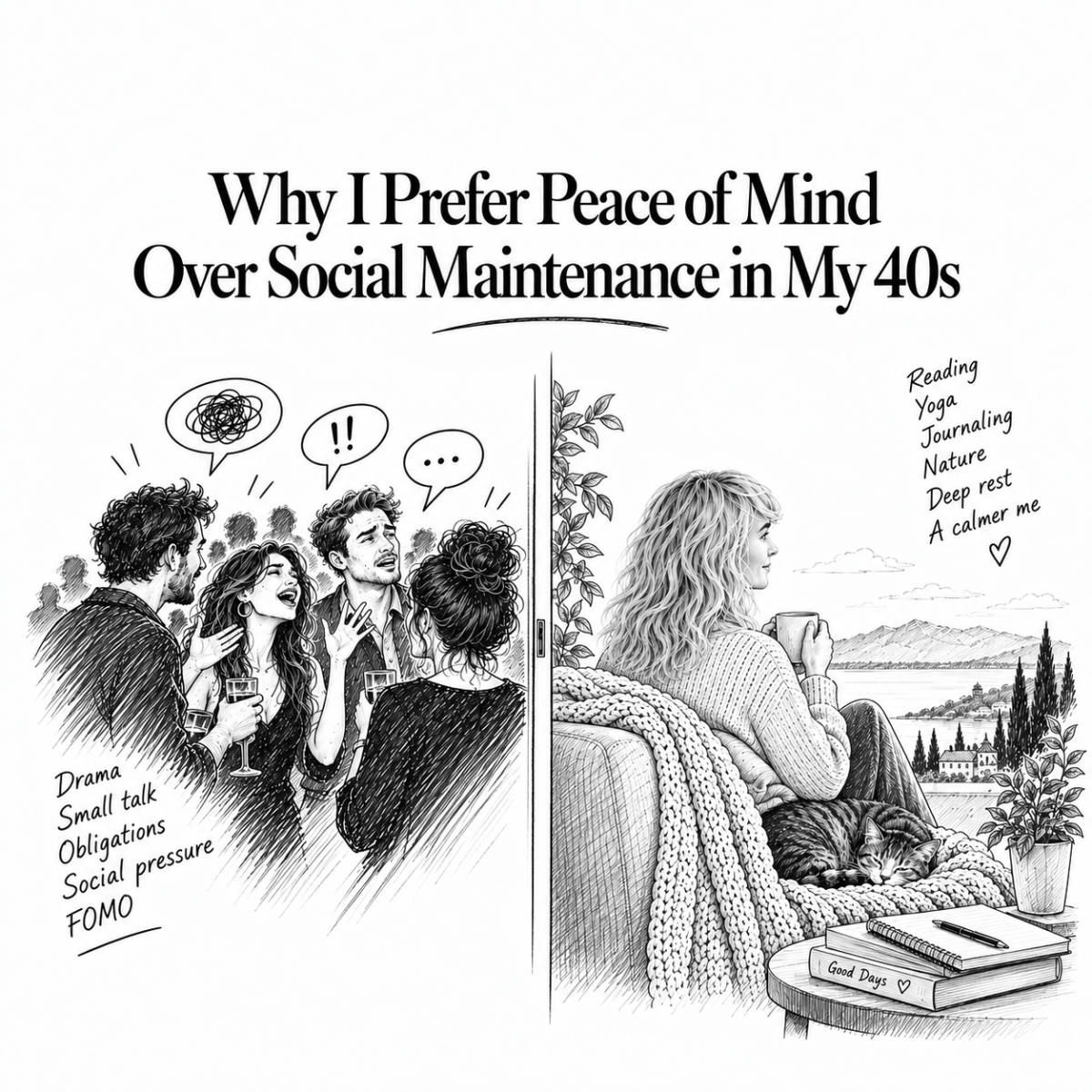
Getting to know myself changed that. I gradually realised that the moments in which I felt most peaceful, energised and genuinely myself were often the ones society had taught me to regard as deficient: living alone, working from home, having enormous amounts of quiet, reading, creating, exercising, meditating and following my own interests without constant interpersonal demands. Conversely, repeatedly forcing myself into social situations in the hope that they would eventually produce happiness often left me tired, irritated or simply longing to go home.
The revelation was surprisingly simple: perhaps I did not need to become better at tolerating the life I was supposed to want. Perhaps I needed to stop distrusting the life I actually enjoyed.
Social Connection Is a Resource, Not a Moral Requirement
Perhaps this is the distinction we need. Social connection can be a tremendous resource. So can solitude. So can creative absorption. So can spiritual practice, exercise, nature, autonomy, learning and meaningful work. Different people need these things in different proportions.
The problem begins when one source of wellbeing is elevated into a universal commandment. “Humans are social animals” may be broadly true, but humans are also enormously variable animals. Some need constant interaction. Some need a handful of close relationships. Some prefer occasional connection surrounded by large amounts of solitude. Some function beautifully with almost none. A population average is not an instruction manual for every individual.
Peace Is Also a Form of Wealth
I have increasingly come to think that peace is dramatically underrated. Not excitement. Not popularity. Not constant companionship. Peace. The kind of peace that comes from closing your own front door and knowing nobody will interrupt you. The peace of working in silence, stretching on the floor, reading for hours, writing something strange, meditating without watching the clock or simply existing without having to respond to another person’s mood.
For someone who genuinely values that state, it is not second-best wellbeing. It is wellbeing. There are undoubtedly extraordinary people out there, and meaningful relationships can be wonderful when they appear. But the possibility of connection does not mean solitude should be treated as a waiting room.
Some of us are not waiting.
We are already home.








Leave a comment