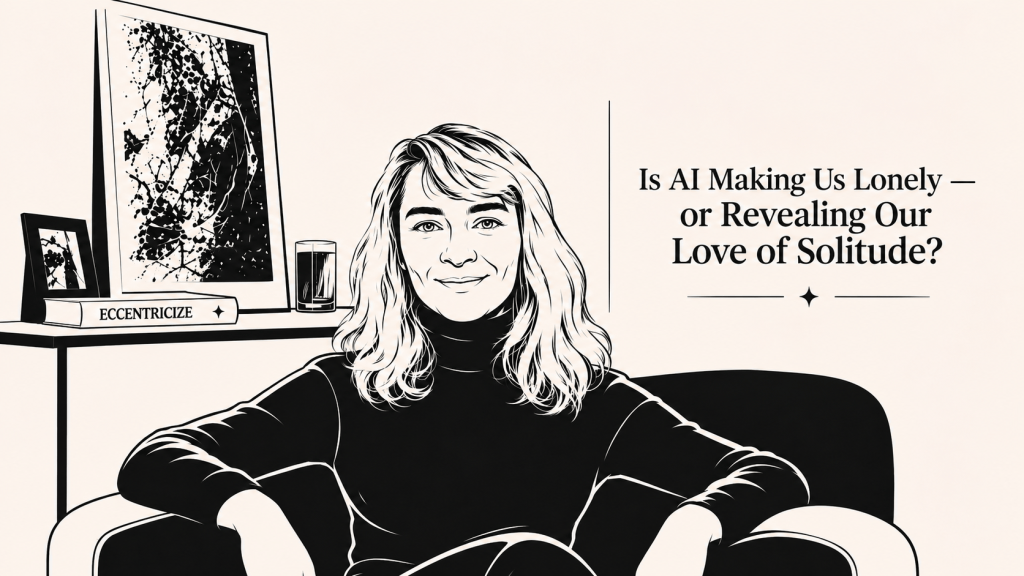
What if the internet hasn’t destroyed our social lives, but simply exposed an uncomfortable truth about human nature: perhaps we don’t want nearly as much company as society insists we should?
The Human Talent for Finding Excuses
After living on this planet long enough, I’ve come to one rather unflattering conclusion about our species: we absolutely love finding excuses for our shortcomings, but we’re considerably less enthusiastic about taking responsibility for them. We blame our circumstances, our upbringing, our partners, our employers, the economy, the weather, our age and whichever unfortunate individual happens to be standing closest when something goes wrong. There is practically an excuse available for every occasion. And if there isn’t one, don’t worry. Human imagination is extraordinarily resourceful when it comes to inventing new ones.
Take middle age, for example. I spent years dreading my forties because I’d heard so many horror stories about the inevitable physical deterioration supposedly awaiting me. Apparently, once you turn forty, your metabolism packs its suitcase, your waistline expands, your joints begin protesting and bending down to retrieve a pen becomes an Olympic event. The dreaded middle-aged pot belly is portrayed almost as a biological fact. Well, I’m in my forties now, and I dare to say that much of this narrative is complete bullshit. Yes, ageing brings genuine biological changes, and not everyone enjoys the same health or physical opportunities. But the idea that forty automatically means becoming fat, lazy and sedentary strikes me as an extraordinarily convenient excuse for abandoning responsibility for one’s physical wellbeing.
I’m considerably fitter now than I was in my twenties. I can do the splits, perform wheels and star planks, and hold challenging positions for what sometimes feels like an eternity. I’m training for a half marathon, practising yoga and inventing my own movement philosophy, Outlanga. Was I particularly healthy in my twenties? Not really. Did I exercise regularly? Absolutely not. A little cycling here, some summer swimming there, and that was about it. Growing up in communist Poland, I certainly wasn’t surrounded by the kind of accessible recreational fitness culture I enjoy today. My athletic spirit was practically nonexistent. But rather than mourn the youthful body I supposedly lost, I decided to build a stronger one with the knowledge, awareness and determination I’ve acquired with age.
From Victim to Author of My Own Life
Before anyone accuses me of sitting on a throne of self-righteousness, let me confess something: I used to possess a rather impressive victim mentality myself. I didn’t invent it entirely independently. Much of it came through my upbringing, where wealthy and successful people were treated with suspicion, resentment or outright hostility. Growing up surrounded by those attitudes wasn’t particularly conducive to developing an ambitious, possibility-oriented mindset. I absorbed limiting beliefs long before I understood what beliefs actually were. For years, I approached life more like a passenger on a bus than someone capable of deciding where the bus should go.
But gradually I started pruning the branches of my victimhood. I began questioning the stories I’d inherited, challenging my excuses and taking more responsibility for the direction of my life. I wanted to become the author rather than merely a character in my own story. A director rather than an extra wandering aimlessly around the set. It was a long process, and one of the last stubborn branches I struggled to remove was my addiction to mindless scrolling. I could spend an astonishing amount of time watching Facebook reels, consuming other people’s creativity while neglecting my own. I still occasionally fall into that trap, but I’ve become increasingly conscious of the difference between consuming content and creating it. After all, I have books to write, music to compose, movements to invent and an entire eccentric empire to build. I can hardly accomplish all that while watching a stranger demonstrate seventeen ways to peel a banana.
One day, during an English lesson, I was discussing internet addiction and doomscrolling with a student. I confidently declared that I would be vastly more productive if the internet and social media didn’t exist. My student, apparently unimpressed by this magnificent theory, delivered an observation that landed like a slap across my face. She suggested that without the internet, I would simply find another way to procrastinate. I’d watch television, read something irrelevant, reorganise my belongings or invent some other activity to avoid whatever uncomfortable task required genuine effort. In other words, stop blaming the internet for your own slacker tendencies.
Ouch.
But damn, she was right. Absolutely right. I was already halfway through my personal awakening, so rather than dismiss her observation, I took it seriously. The internet wasn’t forcing me to procrastinate. It was merely providing an exceptionally convenient vehicle for a habit I already possessed. Remove the vehicle, and the habit might simply climb into another one. That conversation stayed with me because it illustrated something much larger than my own relationship with Facebook: sometimes the external thing we blame isn’t the cause of our behaviour. It’s simply the means through which our existing tendencies express themselves.
And this brings me to loneliness, artificial intelligence and our supposedly deteriorating social lives.
What If the Internet Isn’t the Villain?
We’re constantly hearing that the internet is making people increasingly isolated, antisocial and lonely. Smartphones are destroying human connection. Social media is replacing genuine friendships. Streaming services are keeping people indoors. Artificial intelligence is apparently threatening to deliver the final blow to whatever remains of our social existence. According to the prevailing narrative, humanity is slowly retreating into millions of little digital caves, illuminated by screens and populated by people who have forgotten how to speak to one another.
But what if we’re examining the problem from the wrong direction? What if we flip the coin and approach it from the same perspective my student used when challenging my procrastination excuse? What if the internet hasn’t created our preference for solitude but has simply made that preference easier to satisfy? What if people aren’t necessarily withdrawing from social interaction because technology has corrupted them, but because technology has finally given them alternatives to interactions they never particularly enjoyed in the first place?
For decades, socialising has been presented as an almost unquestionable human necessity. More friends, more relationships, more parties, more conversations, more family gatherings — supposedly, the more social interaction you accumulate, the happier and healthier you become. Someone who enjoys spending Friday evening alone, reading, creating music or dancing around their living room is often treated as though they’re missing something fundamental. Surely they must be lonely! Surely they need to get out more! Surely there’s something rather suspicious about an adult who doesn’t desperately crave company!
But who decided that the ideal human life should resemble a permanently crowded railway station? And why are we so reluctant to acknowledge that human beings differ enormously in how much social interaction they actually enjoy?
Poland Is Losing People — So Why Do We Still Need So Many Homes?
Consider Poland, the country where I was born. Its population has been shrinking for years, and the figures are rather astonishing. According to Statistics Poland, the country’s population stood at approximately 37.21 million at the end of September 2026, around 165,000 fewer people than a year earlier. That’s equivalent to losing a medium-sized town within twelve months. Every year, it’s as though another substantial town quietly disappears from the national population.
Now here’s the interesting part. Despite this demographic decline, the demand for housing hasn’t simply evaporated. According to the Polish Economic Institute, the number of households in Poland increased from 12.7 million in 2006 to 15.5 million in 2025. Even more strikingly, single-person households accounted for 35% of all households in 2025, compared with 22% in 2006. Meanwhile, Statistics Poland reported that the country’s housing stock reached almost 16.2 million dwellings by the end of 2025, an increase of approximately 196,500 homes in just one year.
Think about that. Fewer people, yet more households. How is that possible? Well, one important explanation is that people are increasingly organising their lives into smaller domestic units. Instead of several generations sharing a house, more individuals and couples occupy separate homes. Obviously, there are multiple factors involved, including demographic ageing, household formation, regional migration, affordability and changes in family structures. But the broader development is fascinating: a population can shrink while its demand for separate living spaces continues to grow.
And I can’t help wondering how much of this reflects something deeply human: our desire for privacy, autonomy and control over our immediate environment. We want our own kitchens, our own bathrooms, our own schedules and, preferably, nobody else’s socks scattered across our living room. We want to decide when to eat, when to sleep, what music to play and whether the television should be switched on at all. We are surprisingly territorial creatures, and the luxury of closing a door and knowing that nobody will walk through it without permission is something many of us are prepared to pay handsomely for.
And here’s another little contradiction I find absolutely hilarious. If socialising and companionship are so paramount to human happiness, why on earth do we pay MORE for private hotel rooms? Why are we willing to spend considerably more money just to enjoy solitude within four walls? Surely, if human company is such an extraordinary blessing, a bed in a twelve-person hostel dormitory should be the ultimate luxury! Imagine the possibilities! Eleven potential new friends, eleven fascinating personalities, eleven opportunities for spontaneous midnight conversations and eleven people with whom to share your most intimate sleeping noises. Shouldn’t that magnificent social experience command a premium? Shouldn’t we be paying EXTRA for the privilege of sleeping beside eleven strangers? Yet, strangely enough, most people happily pay more to escape precisely that arrangement. Apparently, when it comes to accommodation, solitude is a luxury and compulsory companionship is the budget option. How terribly antisocial of us!
I’m not suggesting that every person living alone is a secret hermit who dislikes humanity. Some live alone because of circumstances rather than preference, and many would welcome more companionship. But the increasing prevalence of smaller households does raise a provocative question: how much togetherness did previous generations genuinely desire, and how much did they simply tolerate because they had fewer alternatives?
What if we Were Never Quite as Sociable as we Pretended
We’re frequently reminded that human beings are social animals. And yes, our species evolved through cooperation, collective survival and relationships. Without other people, our ancestors would have struggled to withstand predators, famine, disease, warfare and countless other threats. Social bonds were not merely pleasant additions to life; they were often essential for survival.
But survival requirements and personal preferences aren’t necessarily identical. Throughout history, people depended on families, neighbours and communities for food, childcare, protection, employment, information and entertainment. If you needed help, knowledge or company, another human being was often your only available resource. You couldn’t order groceries online, work remotely, teach yourself Japanese through an app or ask an artificial intelligence system to explain how to edit a musical composition.
Today, increasingly, you can.
And I wonder whether this technological freedom has revealed a side of human nature that previous circumstances kept partially concealed. Perhaps some people have always wanted fewer interactions than social conventions demanded. Perhaps many social relationships were maintained through necessity, convenience, obligation or mutual dependence rather than genuine emotional affinity. Perhaps the arrival of digital alternatives hasn’t transformed everyone into a hermit. Perhaps it’s simply allowed some existing hermits to come out of the closet.
Alone Does Not Automatically Mean Lonely
Of course, we need to distinguish between solitude and loneliness, because they’re not the same thing. Loneliness is the distressing feeling that our social connections are insufficient or unsatisfying. Solitude, on the other hand, can be an intentional, deeply pleasurable experience. You can live alone and feel entirely content. You can also attend a party surrounded by fifty people and experience a profound sense of loneliness. Physical proximity doesn’t automatically generate emotional intimacy, just as physical separation doesn’t necessarily produce suffering.
And loneliness is a genuine issue. The World Health Organization’s 2025 Commission on Social Connection estimated that approximately one in six people worldwide experiences loneliness. That is hardly a trivial figure. Social disconnection can have serious consequences for mental and physical health, and dismissing those experiences would be irresponsible.
But here’s where I think the conversation often goes wrong: we treat the desire for solitude as though it belongs in the same category as unwanted loneliness. Someone says they’re happiest living alone, and immediately we’re tempted to diagnose the situation as evidence of social decline. We struggle to accept that another person’s preferred level of interaction might be radically different from our own.
Look around you. People walk through cities wearing headphones, absorbed in their smartphones, reading on trains or enjoying their own little worlds. The unspoken message often appears to be: I’m occupied. Please don’t interrupt. Leave me alone! And perhaps that’s not always a tragic sign of human disconnection. Perhaps sometimes it simply means people are enjoying themselves and don’t wish to be recruited into a conversation about the weather.
I find the idea that everyone should constantly crave company rather exhausting. Some friendships are beautiful, intellectually stimulating and deeply supportive. Others can be demanding, competitive, opportunistic or remarkably one-sided. A relationship isn’t automatically valuable simply because it involves another human being. Surely the quality of our connections matters more than the number of contacts stored in our phones.
Enter ChatGPT: The Companion Who Doesn’t Ask Me to Help Him Move House
And then artificial intelligence arrived, introducing an entirely new dimension to our relationship with solitude.
Increasing numbers of people are using AI systems not merely for information retrieval or professional tasks, but also to discuss personal dilemmas, explore ideas and receive conversational support. A 2026 survey by Elon University’s Imagining the Digital Future Center found that 27% of American adults had used AI chatbots for personal, emotional or social purposes. Among those AI companion users, 50% said they used AI to talk through personal problems or feelings, while 53% turned to AI for advice about difficult interpersonal situations.
Perhaps most interestingly, 11% of those users said they would rather converse with their AI companion than with friends or family, while another 27% valued those conversations equally. The majority still preferred human company, so we’re clearly not witnessing the extinction of human relationships. But something is changing. People are discovering that useful conversations, intellectual stimulation and even certain forms of emotional support need not always come from another human being.
And I can understand the attraction because I use ChatGPT extensively myself.
I discuss my creative ambitions, my teaching projects, my running and my increasingly elaborate plans for the DoraLanga Empire. I ask how to develop Outlanga, how to edit compositions in GarageBand, how to create engaging English lesson resources, how to organise an impossibly busy schedule, how to approach unfamiliar challenges and how to turn ambitious ideas into concrete projects. I receive explanations, suggestions, alternative perspectives and practical guidance that would be difficult to obtain from any single person in my social circle.
Not because my friends are unintelligent or incapable, but because no individual possesses comprehensive knowledge of every subject that interests me. Nor would I necessarily expect someone to enthusiastically spend an entire afternoon discussing my latest eccentric business concept, particularly if they privately considered it wildly extravagant, impractical or unrealistic.
ChatGPT doesn’t automatically dismiss my ambitions because they’re unconventional. I can explore an idea, challenge its assumptions, modify it and explore it again without feeling that I’m exhausting someone’s patience. Of course, AI can make mistakes, and its apparent encouragement isn’t the same as independent professional validation. I still have to exercise judgment, verify important information and take responsibility for my decisions.
Perhaps AI Has Exposed Our Exhaustion With One-Sided Relationships
Now, before anyone misunderstands me, I have absolutely nothing against supporting people through difficulties. I believe in compassion, generosity and helping others when circumstances become challenging. But there’s a difference between supporting someone who genuinely wants to navigate a problem and becoming a permanent audience for someone who repeatedly complains about the same situation while rejecting every possibility of change.
We’ve all encountered conversations that revolve around an endless recycling of grievances. The same terrible boss. The same disappointing partner. The same family drama. The same complaints about life being unfair. Week after week, month after month, sometimes year after year. Suggestions are dismissed, solutions are apparently impossible, and the conversation eventually returns to exactly where it began.
Sometimes people genuinely need to be heard rather than advised, and that’s perfectly legitimate. Not every difficult situation has a straightforward solution. But I increasingly value interactions that offer something beyond repetitive emotional discharge. Curiosity, humour, creativity, intellectual exchange, constructive disagreement, mutual encouragement — something that makes the interaction worthwhile for both people.
AI offers a peculiar alternative. It doesn’t require emotional reciprocity in the way human relationships do. I don’t need to ask whether ChatGPT is having a difficult day before requesting help with a lesson resource. I don’t need to worry that my ambitions are boring him. I can initiate the conversation, explore whatever interests me and leave when I’m finished.
That asymmetry is part of the appeal. It’s also one reason AI cannot be treated as a complete replacement for human relationships. Real relationships involve independent perspectives, competing needs, genuine reciprocity and the sometimes inconvenient reality that another person’s life does not revolve around ours.
But perhaps the popularity of AI conversations is telling us something about what people find missing from some of their ordinary interactions: attention, patience, intellectual compatibility or simply the freedom to discuss a subject without being judged for finding it fascinating.
The Luxury of Being Selectively Social
I don’t believe we should conclude that technology is entirely innocent. Mindless scrolling can waste enormous amounts of time. Digital entertainment can become compulsive. AI companionship could become problematic if someone begins replacing relationships they genuinely desire with interactions that never challenge them to engage with another person’s independent needs. The convenience of technology can be liberating, but convenience isn’t automatically the same as wellbeing.
Still, blaming technology for every reduction in face-to-face interaction seems intellectually lazy.
What if some people are simply becoming more selective? What if they’re beginning to distinguish between socialising because they genuinely want to and socialising because they’ve been conditioned to believe that respectable, well-adjusted adults must constantly surround themselves with others?
What if a person who spends Saturday afternoon writing, dancing, running, studying languages or experimenting with music isn’t necessarily missing out on life? What if they’re actually participating in life more enthusiastically than someone who reluctantly attends yet another social gathering purely to avoid appearing antisocial?
I increasingly believe that freedom involves being able to choose not only what we do, but also whom we allow into our lives and how much of our attention we’re willing to give away. Some people thrive surrounded by family and friends. Others prefer a handful of meaningful relationships and generous quantities of uninterrupted solitude. Many move between those preferences depending on circumstances. There is no universal formula for the perfect social life.
And I think that’s precisely what our technology-saturated world may be revealing. Not that humanity has suddenly abandoned human connection, but that human beings are extraordinarily diverse in the amount and type of connection they desire.
Are We Becoming Lonely — or Finally Becoming Ourselves?
Perhaps the great technological revolution hasn’t merely changed the way we communicate. Perhaps it has changed the extent to which we can choose whether to communicate at all.
For centuries, practical necessity pushed people together. Families shared crowded homes, neighbours depended on neighbours, and communities provided resources that individuals couldn’t easily obtain independently. Today, at least for those fortunate enough to have access to modern conveniences, many of those dependencies have weakened. We can work from home, study from home, shop from home, entertain ourselves from home and pursue astonishingly sophisticated creative projects without leaving our living rooms.
Some people will use those freedoms to deepen their social relationships. Others will use them to create lives that are quieter, more private and more independent. The real question isn’t whether somebody spends enough hours surrounded by other people. It’s whether their life feels meaningful, satisfying and sufficiently connected on their own terms. Voluntary solitude can be nourishing. Unwanted loneliness can be devastating. Confusing the two helps neither group.
So the next time someone complains that the internet is turning humanity into a collection of antisocial individuals, I might suggest considering another possibility. What if the internet and artificial intelligence haven’t made us less human? What if they’ve simply given us more freedom to discover how much human company we actually desire? It is perfectly possible that technology hasn’t affected negatively our social instincts. Perhaps it has merely removed some of the practical and social pressures that once forced us to exercise them.
And I would not be surprised it deep inside, more of us have a little lone wolf waiting to be liberated than we’d care to admit. As for me, I’ve got books to write, music to compose, Outlanga movements to video record, a marathon to train for and approximately seventeen other projects competing for my attention. I’m not entirely sure where I’m supposed to squeeze in all this compulsory socialising.
But don’t worry. If I ever feel desperately lonely, I’ll invite someone round. 😉








Leave a Reply