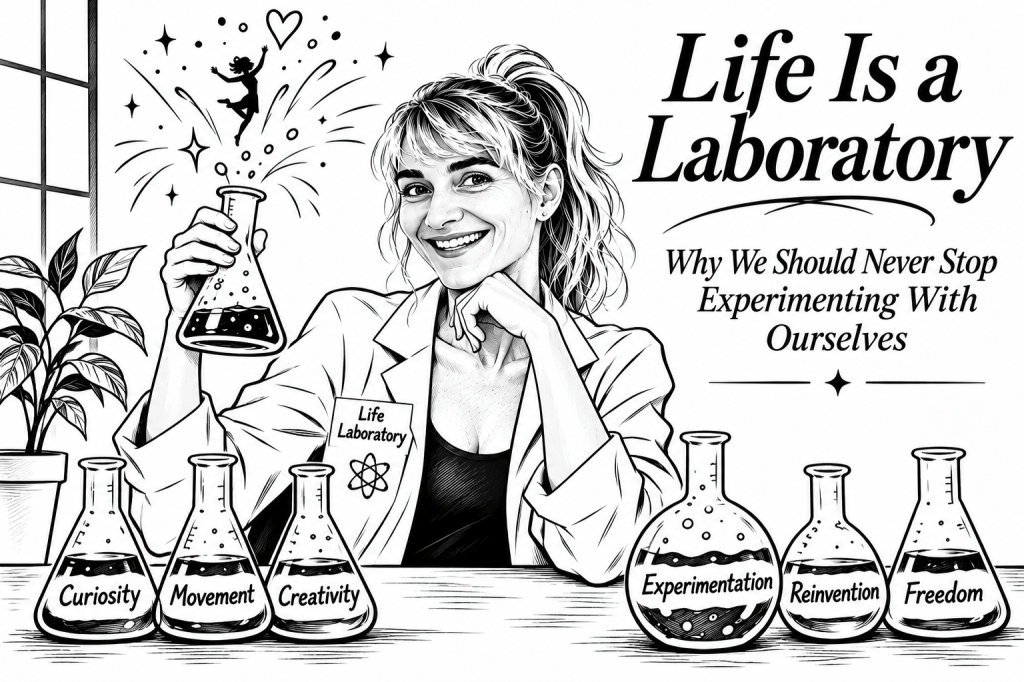
On curiosity, self-discovery, unconventional living and the courage to discover what else we might become.
Are We All Supposed to Want the Same Life?
I am a passionate advocate of experimentation in life. In fact, I consider it one of the most important ingredients of a fulfilling existence. This is also why I am so opposed to blindly following social scripts, particularly when those scripts are presented as the only respectable or sensible way to live. There are more than eight billion people on this planet. Is it really possible that all of them want essentially the same things: finish school, find a respectable job, get married, take out a mortgage, have children, work until retirement and spend their remaining years enjoying whatever freedom they have managed to preserve? Surely not! The idea that billions of extraordinarily complex human beings could all be fulfilled by essentially the same formula strikes me as outrageous. And yet, so much of our education, upbringing and social conditioning seems designed around precisely this assumption.
I am not suggesting that marriage, parenthood, mortgages or conventional employment are inherently undesirable. For some people, they are genuine sources of meaning, stability and happiness. Wonderful! My objection is not to the choices themselves, but to the expectation that everyone should make them, often without seriously considering whether they reflect their own values, temperament and aspirations. A freely chosen conventional life can be every bit as authentic as an unconventional one. The problem begins when people mistake obedience for choice, familiarity for happiness and social approval for personal fulfilment. How many people have ever seriously questioned the path they are following? How many have chosen their lives deliberately, rather than gradually slipping into them because that is what everybody around them appeared to be doing?
From a very early age, we are surrounded by external influences. Parents tell us what matters, teachers reward certain behaviours, employers establish expectations, and society supplies numerous examples of what a successful adult is supposed to look like. We absorb these messages long before we have developed the ability or awareness to question them. Gradually, we learn to follow the socially accepted rhythm, often without noticing that it does nothing to make our hearts skip a beat. We become members of the herd, or what I playfully call sheeple, moving in familiar directions because everyone else seems to be heading that way. But how can you discover your own rhythm, your own melodies, your own tunes and your own beat if you spend your entire life marching to somebody else’s music?
How Can You Know Yourself If You Never Experiment?
I believe that human beings are profoundly multidimensional creatures, full of layers of potential that may never be excavated, explored or even suspected. We are not born with an instruction manual explaining everything we might enjoy, every skill we could develop, every environment in which we might flourish or every unexpected passion waiting to be discovered. Much of that knowledge has to be acquired through experience. Introspection is valuable, certainly, but thinking about doing something is not the same as doing it. You may spend years convinced that you dislike public speaking, only to discover that you love performing in front of an audience. You may assume that you have no artistic ability until you pick up a paintbrush. You may believe that running is dreadful until, after months of perseverance, you suddenly find yourself gliding along the pavement, laughing with exhilaration and wondering how you could ever have lived without it.
This is why I find it so unfortunate that experimentation is frequently dismissed as childish, frivolous, impractical or irresponsible. Adults are expected to become increasingly settled, predictable and consistent. Changing direction is sometimes treated as evidence that we lack commitment, while sticking with the same occupation, identity or routine for decades is automatically interpreted as maturity. But why should consistency be regarded as a virtue regardless of what we are consistently doing? If a particular lifestyle, career or relationship no longer reflects who we are, why should continuing it be more admirable than having the courage to reconsider? There is nothing inherently immature about changing your mind after acquiring new information about yourself. Quite the opposite: recognising that something no longer works can demonstrate remarkable self-awareness.
Experimentation allows us to refine our understanding of who we are. Every unfamiliar activity, new environment, creative project, social encounter or personal challenge provides information. Sometimes we discover a hidden aptitude. Sometimes we encounter an unexpected passion. Sometimes we learn that something we thought would make us happy actually leaves us cold. And sometimes an experiment fails so spectacularly that we end up laughing at our own assumptions. But even then, we have gained something valuable: knowledge. We have tested an idea against reality rather than allowing it to remain an unquestioned fantasy.
How can we possibly know what makes us happy if we haven’t explored enough possibilities to find out?
The Question That Leaves My Adult Students Speechless
As an English teacher working with adults, I have noticed something that genuinely astonishes me. Occasionally, during lessons, we discuss happiness and positive emotions. I might ask my students what makes them happy, what puts them on cloud nine or what gives them genuine pleasure in everyday life. You might expect these to be relatively straightforward questions. After all, who should know more about our happiness than we do?
Yet I am frequently met with an awkward silence.
At first, you might assume that my students are struggling to find the appropriate English vocabulary. But that is not always the case. Some openly admit that they would struggle to answer the same question in their native language. They simply don’t know what to say. They hesitate, search for ideas, offer vague answers and sometimes appear genuinely puzzled by the question. I find this fascinating, and rather sad. These are intelligent, capable adults who manage jobs, responsibilities, finances and complicated daily lives. Yet identifying the experiences that make them genuinely happy can prove surprisingly difficult.
Now, I cannot know precisely why any particular student struggles to answer. Some may be shy, tired or uncomfortable discussing personal matters in a lesson. But these encounters have repeatedly made me wonder how much attention people devote to understanding their own happiness. We spend enormous amounts of time thinking about what we must do, what other people expect from us and which responsibilities demand our attention. But how often do we stop and ask a much more personal question: What actually makes me happy? Not what should make me happy, not what impresses my neighbours, not what my parents would approve of, but what fills me with genuine enthusiasm, contentment, excitement or peace.
And there is another question worth asking: What makes me unhappy? Sometimes becoming happier involves adding wonderful experiences to our lives. At other times, it involves identifying and reducing the things that repeatedly drain us, frustrate us or undermine our wellbeing. We may discover that we need more music, movement, creativity or solitude, but also fewer unnecessary obligations, fewer exhausting social interactions or less time spent pursuing goals we never truly wanted. Happiness is not always about accumulating more. Sometimes it is about making space.
Ten Things That Make Me Happy
Here is a little experiment I would encourage everyone to undertake. Take a notebook and write down ten things that genuinely make you happy. Your list does not need to be impressive, sophisticated or socially acceptable. Nobody is awarding points for having the most intellectual hobbies or the most adventurous lifestyle. You are trying to understand yourself, not impress an imaginary judging panel.
My own list would include movement in almost every imaginable form: dancing, yoga, walking, running and exploring what my body can do. Music comes next, both listening to other people’s creations and inventing my own melodies. I love reading inspiring and uplifting books that introduce me to unfamiliar ideas and encourage me to look at life differently. I treasure silence and solitude, as well as peace and quiet, which may seem amusing considering how much I also enjoy energetic movement and expressive dancing. But these apparently contradictory preferences are part of who I am. I adore delicious coffee, the feeling of having a springy, flexible body, and the pleasure of cooking colourful, appetising meals without necessarily following a recipe. The sea and beaches bring me enormous happiness, and travelling remains one of my greatest passions.
Notice how few of these pleasures depend on achieving conventional milestones. I don’t need to acquire a more prestigious job title to enjoy a beautiful piece of music. I don’t need to be married to experience the exhilaration of running beside the sea. I don’t need anyone’s permission to dance, read, cook or appreciate a wonderful cup of coffee. And while some of my interests require money, many of the most rewarding experiences in my life are surprisingly inexpensive or completely free.
Now imagine that I had never experimented with yoga, running, expressive movement or travelling independently. How many of these sources of happiness might have remained undiscovered? How different would my life look if I had simply accepted an externally prescribed routine and never questioned whether something else might suit me better?
That, to me, is the extraordinary value of experimentation. It doesn’t merely provide entertainment. It can introduce us to previously unknown versions of ourselves.
What Does Science Say About Experimentation?
My enthusiasm for experimentation is rooted primarily in personal experience, but there is also a growing body of psychological and neuroscientific research that helps explain why exploring unfamiliar experiences can be beneficial.
One particularly interesting study, published in Nature Neuroscience in 2020, examined the relationship between the diversity of people’s everyday experiences and their emotional wellbeing. Researchers found that participants who visited a greater variety of physical locations tended to report more positive emotions. The study also identified associations involving communication between brain regions implicated in memory and reward processing. Importantly, this was an observational study, so it cannot prove that visiting new places directly causes happiness. Nevertheless, it offers intriguing evidence that variety in our everyday environments is associated with how positively we feel.
This does not mean that everyone should abandon their routines or pursue endless novelty. Stability and familiarity can be valuable, particularly when they provide safety and emotional comfort. But it does suggest that occasionally introducing variety into our surroundings may enrich our experiences. Taking a different walking route, exploring an unfamiliar neighbourhood, attending a workshop or visiting somewhere new might seem insignificant, yet such activities can interrupt the automatic patterns through which we navigate everyday life.
Another fascinating area of research concerns cognitive flexibility: our ability to approach situations from different perspectives, adjust our thinking and consider alternative solutions. In a 2012 paper published in the Journal of Experimental Social Psychology, Simone Ritter and colleagues investigated how unusual and unexpected experiences might influence creative thinking. Their experiments suggested that certain diversifying experiences can enhance cognitive flexibility. In other words, encountering situations that disrupt our expectations may encourage us to think beyond familiar patterns.
I find this particularly relevant to the pressure to conform. If we repeatedly encounter the same ideas, routines, people and assumptions, we may gradually become accustomed to treating them as the natural order of things. But when we step outside familiar environments, we discover that the supposedly obvious way of doing something is often only one possibility among many. What seems perfectly normal in one culture may be unusual in another. What is considered respectable in one community may be irrelevant somewhere else. Exposure to difference can challenge our assumptions and encourage more flexible thinking.
Research into multicultural experiences reinforces this idea. Studies by William Maddux, Adam Galinsky and their colleagues have linked living abroad and meaningfully adapting to different cultures with improved performance on certain creativity tasks. Crucially, the benefits appear to depend not merely on being physically present somewhere unfamiliar, but on engaging with and learning from different cultural perspectives. Travelling does not automatically make someone more imaginative. We have to be willing to question our assumptions and absorb what unfamiliar experiences can teach us.
Experimentation, the Brain and the Possibility of Reinvention
Neuroplasticity is another fascinating concept associated with learning and change. It refers to the brain’s capacity to adapt through experience, learning and practice. Our brains are not completely fixed structures that stop developing once we reach adulthood. Throughout life, learning can alter the strength and organisation of neural connections, helping us acquire skills and adapt to new demands.
However, the popular claim that every new experience creates beneficial neural pathways and therefore automatically improves creativity is an oversimplification. Different activities produce different forms of learning, and not every change in the brain translates into an improvement in general intelligence or creativity. The evidence is more interesting, and more nuanced, than that.
For example, a study known as the Synapse Project, published in Psychological Science in 2014, examined the effects of sustained engagement in demanding new activities among older adults. Participants who spent several months learning challenging skills, including digital photography and quilting, showed improvements in certain measures of memory compared with participants engaged in less demanding activities. The findings suggest that sustained learning and active engagement can provide cognitive benefits, although they do not imply that every hobby will produce the same results.
What excites me about this research is the broader message: adulthood does not have to mark the end of learning, growth or discovery. We can continue to acquire unfamiliar skills, challenge our abilities and develop new interests long after society has decided that we ought to be settled in our ways.
Why should a woman in her forties not take up marathon running? Why should someone in their sixties not learn to dance? Why should a retired accountant not begin writing poetry, or an experienced teacher decide to become an artist? We often discuss personal development as though it belongs primarily to young people, but curiosity has no official retirement age.
Autonomy: The Psychological Importance of Living on Your Own Terms
There is another scientific perspective that I consider particularly relevant to the philosophy of Eccentricize: self-determination theory. Developed by psychologists Edward Deci and Richard Ryan, this influential framework identifies three basic psychological needs associated with healthy motivation and wellbeing: autonomy, competence and relatedness.
Autonomy involves experiencing a sense of ownership over our actions, rather than feeling constantly controlled by external demands. Competence concerns our ability to develop skills and engage effectively with challenges. Relatedness involves meaningful connection with other people. These needs are not mutually exclusive. We can be fiercely independent while maintaining warm relationships, or pursue unusual ambitions while belonging to a supportive community.
A large 2024 meta-analysis drawing on 881 independent samples found strong associations between support for these psychological needs and greater need satisfaction, motivation and wellbeing. Research of this kind does not demonstrate that unconventional lifestyles are automatically happier than conventional ones. It does, however, support the importance of allowing people meaningful choice and opportunities to develop their capabilities.
This distinction matters enormously. I am not advocating eccentricity for the sake of appearing different. Deliberately rejecting every convention would be just another rigid rule to follow. What I advocate is the freedom to examine conventions, retain those that genuinely serve us and abandon those that do not. An authentic life might include marriage, children and a traditional career. It might include solo travel, creative self-employment and a complete rejection of conventional domestic expectations. It might combine elements of both. The important question is whether the person living that life has chosen it consciously.
Experimentation helps us answer that question because it gives us alternatives against which to evaluate our assumptions. Without alternatives, even an unsatisfying situation can begin to feel inevitable.
My Own Life Has Been One Enormous Experiment
You might reasonably wonder whether I practise what I preach. Have I actually experimented with different ways of living, or am I simply sitting comfortably at home telling everyone else to be adventurous?
Well, experimentation has become something of a personal philosophy for me, and my life has involved a wonderfully unpredictable collection of experiences. Among them was a ten-day silent Vipassana meditation retreat, where I explored the experience of prolonged silence, disciplined meditation and a radically different daily routine. I also completed 500 hours of yoga teacher training in Rishikesh, India, immersing myself in the physical, philosophical and educational dimensions of yoga. These experiences were certainly not interchangeable, but each exposed me to unfamiliar practices and encouraged me to reconsider aspects of myself that I might otherwise have taken for granted.
I have experimented with different eating patterns, including liquid diets and fasting, with my longest water fast lasting seven days. I mention these as part of my personal history, not as recommendations: prolonged fasting can carry medical risks. Proper experimentation requires judgement, awareness of risk and a willingness to abandon an approach that proves unhelpful.
Other experiments have been more conventional. I have explored morning pages and handwritten journalling, allowing myself to write freely and observe the strange, fascinating material that emerges when thoughts are given room to develop. I have tried unfamiliar forms of physical movement, travelled independently, changed routines and pursued interests that initially seemed unrelated to my professional life.
Running has been one of my most surprising discoveries. I began with little indication that it would eventually become such an important part of my existence. Yet here I am, having completed half-marathons and now training for my first full marathon. What began as something to try has developed into a source of physical confidence, challenge, exhilaration and joy. There have been moments when running has felt so effortless that I could almost imagine myself levitating above the pavement. Had I dismissed the activity after my earliest experiences, I might never have discovered that extraordinary sensation.
Some of my biggest experiments have involved my professional life. Leaving conventional employment, becoming self-employed and teaching English online required me to abandon the reassuring predictability of a traditional workplace. Later, I experimented with combining online work and travel, spending extended periods exploring Southeast Asia while continuing to earn a living. These decisions involved uncertainty, adjustment and occasional difficulties, but they also opened possibilities that would have remained inaccessible had I insisted on following the most conventional career path.
Then there are my more eccentric experiments, which I enjoy giving suitably dramatic names. One of them is Dora Primitivo, my personal experiment in questioning modern habits and assumptions about comfort. This winter, I am curious to discover how long I can comfortably manage without switching on my central heating. It is partly an exercise in resourcefulness, partly an exploration of my relationship with comfort, and partly an opportunity to question the assumption that we must immediately reach for modern conveniences whenever conditions become slightly uncomfortable. Naturally, I have no intention of turning this into a dangerous endurance competition. Maintaining a safely warm, dry home and recognising when the heating is necessary are non-negotiable. I am interested in understanding my preferences and habits, not proving that I can tolerate harmful cold.
And then there is an experiment that sounds even more deliciously absurd: the Outlanga Marathon! Having developed my own expressive movement practice, I am increasingly curious about how long I could continue dancing while remaining comfortable, coordinated and energised. Could I dance for four hours? 5 hours? Longer? What happens to my sense of rhythm, concentration, creativity and physical energy as a movement session progresses? Would my movements become more spontaneous, or would fatigue gradually demand a different approach? I find these questions fascinating, especially because Outlanga combines so many different forms of movement and self-expression. Rather than treating the experiment as an invitation to dance until exhaustion, I imagine approaching it as a carefully planned endurance challenge, with appropriate preparation, hydration, food, breaks and clear stopping points.
What I particularly enjoy about Dora Primitivo and the Outlanga Marathon is that neither experiment requires anyone else’s approval or participation. They arise from my own curiosity. One concerns everyday comfort and resourcefulness; the other concerns movement, creativity and endurance. Both remind me that experimentation need not involve grand journeys, expensive equipment or dramatic changes of career. Sometimes the most interesting questions emerge from ordinary life: What habits have I accepted without examination? What am I capable of learning? What might happen if I approach a familiar experience differently? The important thing is to ask meaningful questions, observe the results and remain willing to adjust the experiment when necessary.
And now there is Eccentricize itself. This blog is an enormous experiment in writing, self-expression, creativity and sharing my ideas publicly. I don’t know precisely where it will lead, and that is part of the excitement. I am writing because I have things I want to explore and express, and because I find the process itself immensely rewarding.
My latest creative experiment is Outlanga, an expressive movement practice I have developed around freedom, spontaneity, physical exploration and joyful self-expression. It combines elements of dance, yoga and other movement influences. Its guiding philosophy is simple: stop being embarrassed to be alive. Why should adults feel ashamed of moving playfully, dancing enthusiastically or expressing happiness through their bodies merely because such behaviour does not fit the expectations of a particular setting?
And the experiments continue. I want to introduce my own musical creations, Dothleen tunes, develop webinars, explore podcasting and pursue new creative projects. Some may flourish, others may change direction, and still others may teach me that a particular idea was not worth pursuing. I am perfectly comfortable with that uncertainty. Life would become terribly dull if I insisted on knowing the outcome of every experiment before beginning.
Am I enjoying myself? Absolutely. I feel more curious, more engaged and more excited about the possibilities ahead than ever before.

Why Failure Should Be Part of the Experiment
One of the greatest obstacles to experimentation is our fear of failure. We are often taught to regard unsuccessful attempts as evidence of incompetence, poor judgement or personal inadequacy. Consequently, many adults become reluctant to try anything unless they believe they can perform it reasonably well from the beginning.
But imagine applying that standard to scientific research. A scientist does not necessarily expect every hypothesis to be confirmed. An experiment that contradicts an initial assumption can still provide valuable information. The result may be disappointing, but disappointment is not the same as uselessness.
I believe we could benefit from adopting a similar attitude towards our own lives. If you take a dance class and discover that you dislike it, you haven’t wasted the evening. You’ve learnt something about your preferences. If you try painting and produce something that resembles a catastrophic collision between a cabbage and a thunderstorm, you may still have enjoyed the experience. If you launch a small creative project that attracts little interest, you may nevertheless develop useful skills, discover unexpected weaknesses or generate ideas for something better.
And sometimes an experiment succeeds precisely because it teaches us when to stop. If I switch on the heating earlier than I originally imagined during Dora Primitivo, that is not a defeat; it is evidence that the conditions require a different decision. If an Outlanga Marathon ends sooner than expected because my body needs rest, I have still learnt something about endurance, recovery and sensible limits. The purpose of experimentation is not to prove that our original expectations were correct. It is to discover what actually happens.
Of course, life experiments are not laboratory experiments conducted under perfectly controlled conditions. Some decisions involve serious financial, physical or emotional consequences. Leaving a job, relocating abroad or undertaking demanding physical challenges requires considerably more preparation than trying a new recipe. Experimentation should never become an excuse for recklessness. But the existence of risk does not justify refusing to explore anything unfamiliar. We can begin with small, reversible experiments and gradually develop the confidence and knowledge needed for larger changes.
I particularly dislike the assumption that every hobby must eventually become productive, profitable or impressive. Why can’t we do something simply because it gives us pleasure? Why must dancing become a performance, writing become a business or running become a competition? Sometimes the most valuable outcome of an experiment is the happiness experienced while doing it.
Happiness May Be Hiding in Experiences You Haven’t Tried Yet
There is one final thought I find both exciting and slightly unsettling: what if some of the things that would make us happiest are things we have never experienced?
Imagine someone who has spent forty years believing they have no interest in music, only to discover an extraordinary love of playing the piano. Or a woman who has always considered herself unathletic and then discovers the exhilaration of swimming in open water. Or someone who has never enjoyed conventional social gatherings but finds genuine belonging in a community of artists, dancers or unconventional thinkers.
These possibilities exist because our understanding of ourselves is necessarily incomplete. We cannot fully anticipate how we will respond to situations we have never encountered. Some of our strongest preferences are discovered through direct experience, while others change as we grow older, encounter new people and develop different capacities.
Research into openness to experience also suggests that our willingness to engage with unfamiliar possibilities is not entirely fixed. For example, experimental studies have found that reflecting on certain positive or novel experiences can temporarily increase measures of openness. That does not mean a single unusual activity will permanently transform someone’s personality. It does, however, challenge the assumption that curiosity and receptiveness must remain unchanged throughout adulthood.
This is why I find the expression “That’s just the way I am” so limiting when it is used to reject every possibility of change. Sometimes it reflects genuine self-knowledge, and that deserves respect. But sometimes it functions as a convenient explanation for avoiding discomfort. How can we be certain that something is incompatible with our nature if we have never seriously explored it?
Perhaps there are dormant musicians, runners, writers, gardeners, performers, inventors and adventurers living inside people who have never given those possibilities a chance to emerge. Perhaps some of us have spent decades identifying ourselves primarily through our occupations, relationships or responsibilities while neglecting entire dimensions of our personality.
What a tragedy it would be to reach the end of life having discovered only a fraction of who we might have become.
Become the Scientist of Your Own Life
So here is my invitation: start treating your life as a laboratory and yourself as a curious, observant and occasionally mischievous scientist. You do not need to resign from your job, move to another continent or undertake a dramatic transformation. Start with something manageable. Take a different route home. Read a book you would ordinarily dismiss. Attend an unfamiliar class. Learn a few notes on an instrument. Try writing a poem, dancing in your living room, cooking an unfamiliar dish or spending an afternoon somewhere you have never visited.
Observe what happens. Did the experience energise you? Did it make you uncomfortable? Did you discover something interesting? Would you like to repeat it? And if not, what did you learn?
Then try something else.
You could even establish a personal experiment of the month, choosing one new experience every four weeks. Keep a notebook of your discoveries, including the things that surprised you, disappointed you or challenged your assumptions. Over time, you may begin to notice patterns in what brings you joy, what drains your energy and what kind of life genuinely suits you.
And please, do not allow other people to dismiss your experiments as childish simply because they fall outside conventional expectations. Playfulness, curiosity and imagination are not qualities we should be expected to surrender upon reaching adulthood. Nor is reinvention something reserved for people experiencing a crisis. You are allowed to change because you are curious, because you have discovered a new passion or simply because you want to find out what else life might contain.
Above all, remember that experimentation is not about endlessly reinventing yourself to escape who you are. It is about becoming better acquainted with yourself, including the aspects that have never been given an opportunity to emerge. It is about discovering your preferences, recognising your values, testing your assumptions and developing the courage to live according to what you learn.
We are given an extraordinary world full of people, ideas, cultures, activities, experiences and possibilities. Why reduce that richness to a narrow collection of socially approved milestones? Why spend our entire existence repeating a familiar rhythm when we have the capacity to discover melodies of our own?
You are not a finished product. You are an unfolding possibility.
So remain curious. Experiment. Explore. Learn. Change your mind. Surprise yourself. Reinvent whatever needs reinventing, and cherish whatever genuinely brings you happiness.
And if the world insists that you should behave like a perfectly predictable adult, perhaps your next experiment should be to do something wonderfully, harmlessly eccentric instead.
After all, life is not merely something to get through.
It is something to discover.
Research and further reading
- Heller, A. S., et al. (2020). Association between real-world experiential diversity and positive affect relates to hippocampal–striatal functional connectivity. Nature Neuroscience. https://doi.org/10.1038/s41593-020-0636-4
- Ritter, S. M., et al. (2012). Diversifying experiences enhance cognitive flexibility. Journal of Experimental Social Psychology. https://doi.org/10.1016/j.jesp.2012.02.009
- Maddux, W. W., & Galinsky, A. D. (2009). Cultural borders and mental barriers: The relationship between living abroad and creativity. Journal of Personality and Social Psychology. https://doi.org/10.1037/a0014861
- Park, D. C., et al. (2014). The impact of sustained engagement on cognitive function in older adults: The Synapse Project. Psychological Science. https://doi.org/10.1177/0956797613499592
- Hotchin, V., & West, K. (2021). Reflecting on nostalgic, positive, and novel experiences increases state Openness. Journal of Personality. https://doi.org/10.1111/jopy.12580
- Interpersonal supports for basic psychological needs and their relations with motivation, well-being, and performance: A meta-analysis (2024). https://pubmed.ncbi.nlm.nih.gov/38635183/





Leave a Reply