On becoming a stone, dispersing dark clouds and evicting unwanted visitors from the garden of your delights.
When I teach English online to teenagers, we sometimes discuss things we can control and things that are beyond our control. What fascinates me is how many young people firmly believe that we have absolutely no control over our emotions, particularly the unpleasant ones: grief, disappointment, anger, jealousy, resentment or shame. They seem to regard emotions as mysterious forces that descend upon us without warning, seize control of our minds and toss us around like a little paper boat in a stormy ocean. We are helpless puppets, dragged from one emotional catastrophe to another, with little hope of escaping the tempest until it eventually subsides of its own accord. And I find this fascinating because I used to believe exactly the same thing. Not only did I consider myself entirely helpless in the face of negative emotions, but I was also remarkably skilled at harbouring them for days, sometimes even longer. I didn’t know how to disperse them, question them or transform them into something less destructive. I simply allowed them to occupy my mind, settle comfortably into every corner of my consciousness and make themselves at home.
I remember how, as a young student, receiving a disappointing grade could plunge me into days of self-contempt and misery. A poor result wasn’t merely evidence that I had performed badly in a particular test. Oh no! It was conclusive proof that I wasn’t intelligent enough, wasn’t good enough, and perhaps never would be! What an extraordinary leap of logic! From one disappointing mark to an entire verdict on my intellectual worth! And yet I accepted that verdict without questioning it. I would marinate in my own disappointment, revisiting the unpleasant experience, reinforcing my negative conclusions and practically feeding the emotion until it grew into something much larger than the original event. I had no idea that there was another way of responding. Nobody had taught me that thoughts could be challenged, interpretations reconsidered and emotions regulated. I believed that what I felt was an unquestionable truth about myself and the world.
The Woman Who Told Me to Become a Stone
I’ll never forget an incident from approximately ten years ago, when I had just started working as a teaching assistant in a specialist secure education unit. I was brimming with enthusiasm, energy and ideas. I couldn’t wait to contribute, support students and make myself useful. Lessons were often delivered one-to-one, and I was allocated to assist a teacher during one of them. However, when I arrived, the teacher informed me that my assistance wasn’t needed. They would be perfectly fine without a teaching assistant. To anybody else, this might have seemed like a perfectly ordinary practical decision, barely worthy of a second thought. But to me, at that particular moment, it was devastating. I felt rejected, unnecessary and utterly useless. All my enthusiasm seemed to evaporate. I remember retreating somewhere into an empty classroom and quietly crying, overwhelmed by the conviction that I had somehow failed before I’d even had a chance to begin.
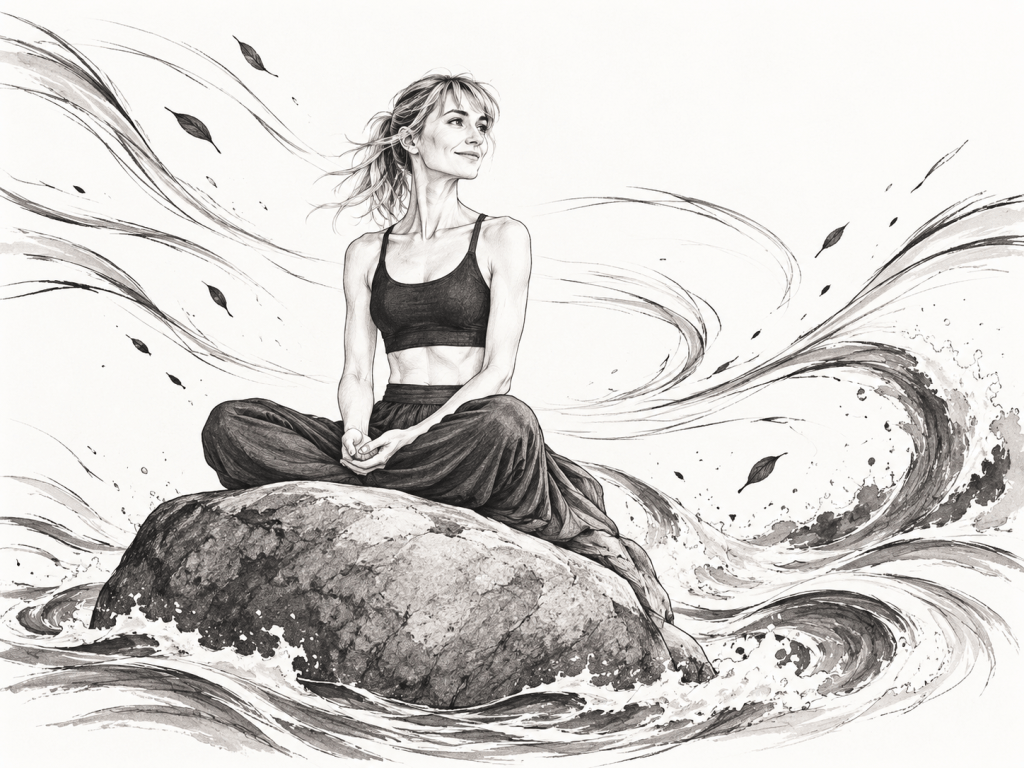
My head of department, who would later become my mentor, noticed that something was wrong and invited me into her office. She was a jovial woman in her late fifties or early sixties, warm-hearted, experienced and, interestingly, a Buddhist. After listening to my miserable account of the incident, she offered me a piece of advice that I have never forgotten. “Dora, you have to be like a stone.” A stone! I looked at her in complete disbelief. How on earth was I supposed to become a stone? I was a human being, for goodness’ sake! A human being with emotions, sensitivities, hopes, fears and disappointments! Was she suggesting that I should stop feeling altogether? Become cold, indifferent and unresponsive? I simply couldn’t comprehend what she was trying to tell me. Her Buddhist-inspired wisdom seemed utterly incompatible with my understanding of what it meant to be human.
But that was ten years ago. Ten years filled with lessons, books, training, meditation, self-reflection, the study of human nature, my NeuroNinjas learning and 500 hours of yoga teacher training. Ten years of observing my own reactions, questioning my assumptions and slowly discovering that the workings of the human mind are far more flexible than I once imagined. And today I can say, with enormous affection and gratitude towards that remarkable woman, that she was so, so right! I finally understand the stone. A stone does not have to prevent the river from flowing. It does not have to command the currents to disappear or demand that the water become perfectly still. The river can rush around it, waves can crash against it, and powerful currents may even dislodge it, but the stone does not need to become the river. It has its own substance. Its own weight. Its own existence. What a beautiful metaphor for emotional resilience! We cannot always stop life’s currents, and sometimes they really do knock us over, but we can gradually learn not to surrender our entire inner world to every passing disturbance.
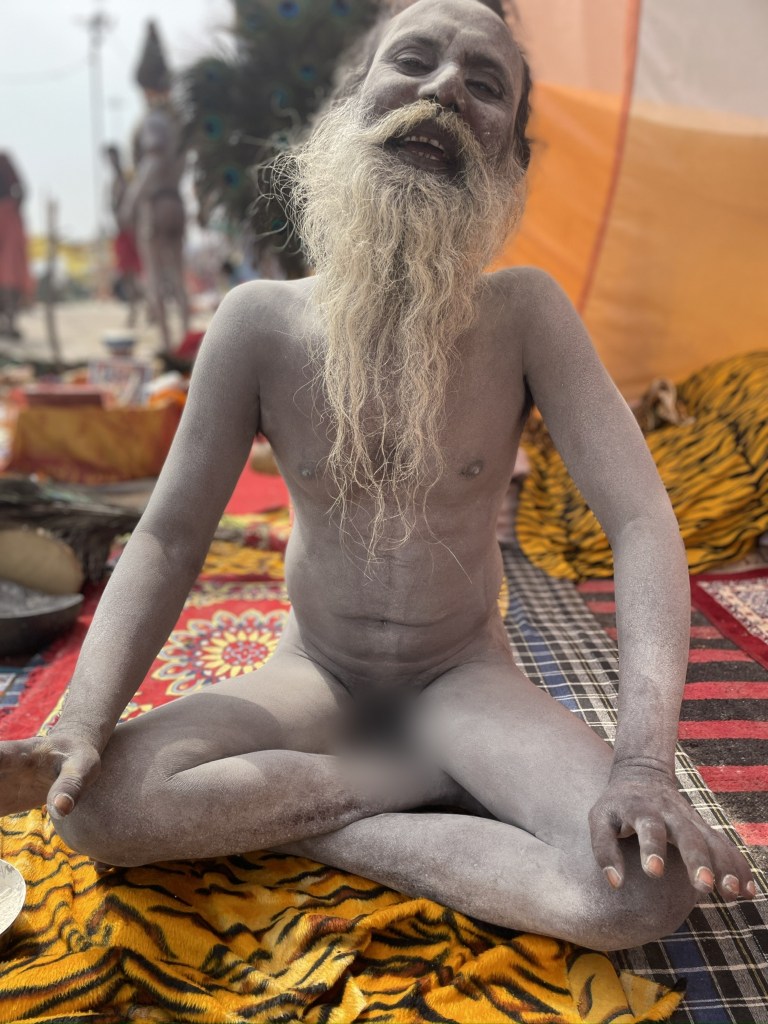
Years later, during my travels through India, I encountered this wonderfully cheerful sadhu in Varanasi. His body was covered in ash, his long beard flowed over his chest, and he sat cross-legged, surrounded by the exuberant colours of India, wearing a smile so magnificent that I couldn’t resist photographing him. I have no idea what thoughts were passing through his mind or what struggles he might have experienced in life, but something about that moment has stayed with me. Here was a man belonging to a spiritual tradition in which detachment, meditation and the examination of human suffering have occupied thinkers and practitioners for centuries, and yet the expression I captured was one of sheer delight! It reminded me that emotional steadiness need not mean emotional dullness. Becoming a stone doesn’t mean becoming lifeless, joyless or incapable of experiencing the extraordinary pleasures of being human. Perhaps the ultimate aspiration is not to feel less, but to suffer less unnecessarily, while remaining gloriously receptive to joy. And if that means occasionally grinning like a delighted sadhu in the middle of Varanasi, then so much the better!
He Made Me So Angry! Did He Really?
How often do we hear people declaring, “He made me so angry!” or “She ruined my day!” or “That comment made me feel worthless!”? I hear such statements constantly, and I used to make them myself. But consider the enormous power we are handing over to another person when we speak like this. Someone says something unpleasant, behaves rudely or disappoints us, and suddenly we appoint that person the supreme ruler of our emotional universe. They are given permission to dictate our mood, poison our afternoon and occupy our thoughts long after the actual interaction has ended. Sometimes we continue arguing with them in our imagination for hours, producing increasingly elaborate speeches in defence of ourselves, while the supposed offender has probably gone home, eaten dinner and forgotten the entire encounter!
Now, I’m not suggesting that we consciously choose every emotion the moment it appears. Anger, fear and sadness can arise automatically, sometimes with extraordinary force, and nobody should be blamed for experiencing them. But there is a crucial distinction between the initial emotional reaction and what happens next. We can learn to influence how we interpret an event, how much attention we give it, what we tell ourselves about it and how we respond. Instead of automatically declaring, “He made me angry,” I sometimes experiment with a different formulation: “I became angry in response to him. What am I going to do with that anger?” Or, more provocatively, “Am I choosing to keep this anger alive?” The first spark may not have been my choice, but I can often choose whether to keep adding fuel to the fire. And suddenly the balance of power begins to shift. The other person may have behaved badly, but they do not automatically get unlimited access to my peace of mind.
I have also learnt to ask myself a few uncomfortable but illuminating questions. Why did this particular remark upset me so much? Did it touch an old insecurity? Did I interpret an innocent comment as criticism? Am I expecting somebody else to behave according to a script I have written for them without their knowledge? Could this unpleasant interaction reveal something about my own expectations, vulnerabilities or assumptions? Could I become more open, both towards the other person and towards myself? Of course, not every unpleasant experience is a misunderstanding, and sometimes anger is an entirely appropriate response to genuine injustice, cruelty or disrespect. Emotional regulation isn’t about excusing bad behaviour or tolerating mistreatment. Sometimes the most sensible response is to establish a boundary, confront a problem or walk away. But even then, there is an enormous difference between acting from a position of awareness and allowing anger to drag us blindly wherever it pleases.
Dark Clouds, Black Balloons and the Garden of My Delights
One of my favourite metaphors describes negative emotions as dark, heavy clouds gathering across the sky. They can appear enormous, threatening and all-consuming, blocking the sunlight and convincing us that darkness is all that exists. But our consciousness is something much larger than any passing cloud. The sky remains the sky, even when it is covered by a storm. This idea has become particularly meaningful to me through meditation and yoga. I can observe an emotion without immediately identifying with it. I can notice sadness without declaring myself a miserable person, acknowledge anger without becoming an angry person, and experience disappointment without turning it into a prophecy of permanent failure. The cloud is present, yes, but it is not the entire sky. And although we cannot always command clouds to disappear, we can learn not to mistake temporary weather for the permanent condition of our inner world.
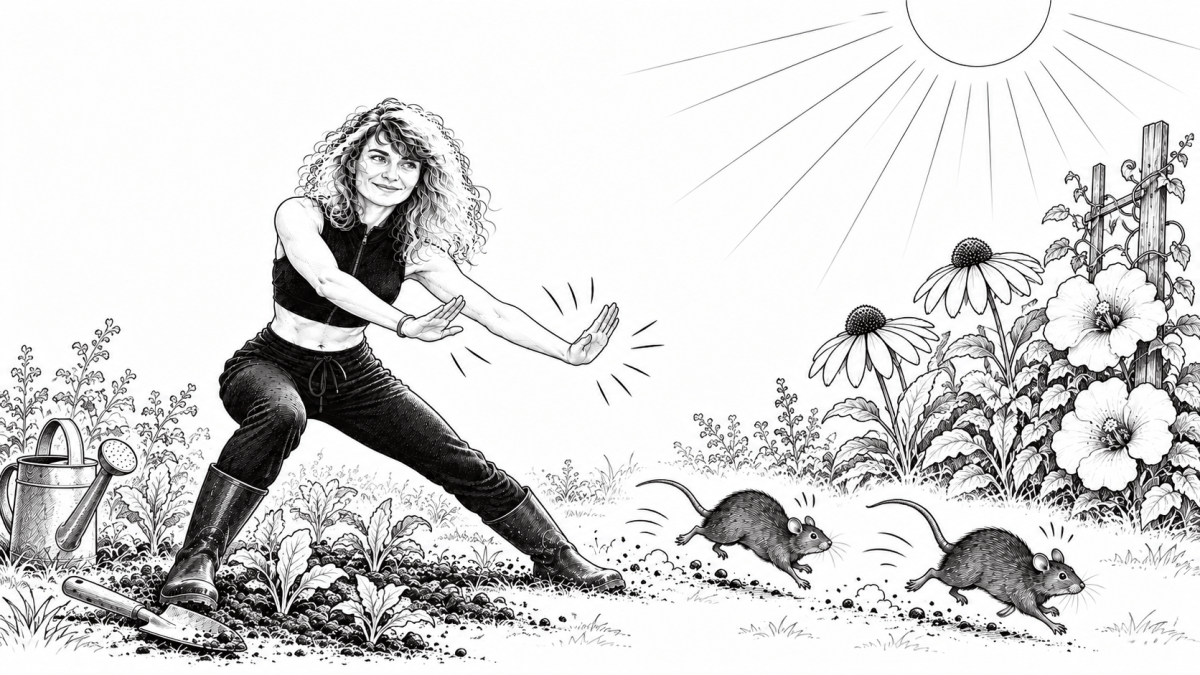
Over the years, I have developed some techniques for dealing with unwelcome emotions. One involves giving them physical shapes and faces. I imagine resentment, self-doubt or bitterness as ugly little pests invading the beautiful garden of my delights. There they are, crawling over the flowers, trampling the grass and making themselves thoroughly objectionable! But instead of allowing them to multiply and establish a permanent colony, I imagine myself shooing them away. Out! Off you go! You are not welcome here! Another technique involves transforming unpleasant emotions into large black balloons and then popping them, one after another, until the imaginary sky is clear again. POP! There goes resentment! POP! There goes wounded pride! POP! Goodbye, pointless self-contempt! I realise these images may sound rather ridiculous, but that’s partly their charm. They interrupt the solemnity with which we sometimes treat our suffering and give me a playful way to regain perspective.
And humour is another magnificent instrument of emotional liberation. I have written elsewhere about the art of transforming people who have hurt or irritated us into satire. There is something extraordinarily satisfying about taking an unpleasant encounter, examining its absurdities and turning it into a little comedy. The pompous person becomes a ridiculous character, the infuriating exchange becomes a theatrical scene, and the event that once seemed so personally devastating suddenly reveals its comic potential. This isn’t about denying genuine pain or laughing at serious harm. It’s about recognising that not every unpleasant interaction deserves to become a tragedy. Sometimes it deserves to become a farce! And I would much rather be the author of a little comedy than the perpetual victim of somebody else’s bad manners or intrusive nature.
Interestingly, psychology has names for some of these processes. Cognitive reappraisal involves changing the way we interpret an event so that its emotional impact changes. Mindful acceptance involves noticing and allowing feelings without immediately fighting or judging them. There is no single magic trick that works for everyone, and some feelings need patience, support or practical action rather than an imaginary balloon-popping visualizations. But discovering that emotional regulation is something we can learn was tremendously empowering for me. I had spent so many years assuming that the contents of my mind were simply happening to me. Suddenly I understood that I could be proactive and even creative in shaping my responses. What an extraordinary revelation!
Moving, Writing and Thinking Our Way Out of Misery
And there are so many other ways of dispersing those miserable emotional states! One of my favourites is writing. Journaling allows me to empty the contents of my overcrowded mind onto paper, examine them from a distance and sometimes discover that the terrible catastrophe I have been entertaining in my head is, in fact, nothing more than a rather insignificant inconvenience! Writing forces me to articulate what exactly has upset me, why it has upset me and whether my interpretation of the situation is even remotely reasonable. Sometimes, halfway through describing an unpleasant encounter, I suddenly notice its absurdity and burst out laughing! Physical movement is another magnificent remedy. Running, dancing, yoga, vigorous exercise — anything that gets the body moving and interrupts the endless carousel of miserable thoughts!
I have discovered that it is remarkably difficult to continue wallowing in self-pity while running through a park, dancing ecstatically around my living room or concentrating on a demanding yoga posture. Try maintaining a tragic internal monologue while balancing in crow pose! Physical activity can shift our attention, release tension and change our emotional state in astonishing ways. And then there is the art of deliberately redirecting our attention towards the good things in life. Why do we so readily allow one unpleasant incident to overshadow a hundred wonderful experiences? Why should one rude remark outweigh a beautiful morning, a delicious meal, a kind stranger, a healthy body, a comfortable home or the sheer pleasure of being alive? Our minds have a tendency to cling to negative experiences, but we can consciously practise noticing the positive ones too. Gratitude, to me, isn’t about pretending that everything is wonderful or denying life’s difficulties. It’s about refusing to let those difficulties monopolise the entire landscape of our consciousness. Sometimes all it takes is a change of perspective, a good run, a few pages of uninhibited writing or a gloriously ridiculous dance around the room to remind ourselves that life contains considerably more than the particular misery currently demanding our attention. Why spend the entire day staring at one ugly weed when the garden is overflowing with flowers?
Why Aren’t We Teaching This in Schools?
And this brings me back to my teenage English students, many of whom seem convinced that emotions are entirely beyond human influence. Why aren’t we teaching children and young people more systematically about emotional self-regulation, stress management, anger, disappointment, jealousy and the peculiar tricks our minds play on us? We teach them how to solve equations, analyse literary characters and remember historical dates, yet some leave school without knowing what to do when they feel humiliated by failure, consumed by jealousy or overwhelmed by anger. I’m certainly not suggesting that mathematics, history or classical literature should disappear from education. Literature itself can be an extraordinary vehicle for exploring human emotions! But surely learning to understand one’s own mind deserves a prominent place alongside academic knowledge. What use is an impressive collection of examination certificates if a person remains entirely at the mercy of every disappointment and perceived rejection?
I recently read about the Danish practice of klassens tid, or class time, in which pupils are encouraged to discuss problems, listen to one another and develop empathy. Reports often trace this approach back to the 1990s and associate it with Denmark’s emphasis on cooperation and social wellbeing. I also came across claims that such education has helped reduce bullying, although I would be cautious about attributing any national decline in bullying to one classroom practice alone. Nevertheless, the underlying idea fascinates me. What if schools devoted serious attention to understanding emotions, resolving conflicts, developing empathy and recognising the difference between a fact and an interpretation? What if children learnt that receiving a poor grade does not make them unintelligent, being excluded from one activity does not render them worthless, and another person’s unpleasant behaviour need not determine the quality of their entire day?
Imagine a generation of young people equipped not only with academic knowledge but also with a practical vocabulary for understanding their inner lives. Young people who could recognise the beginnings of resentment before it hardened into hostility, question catastrophic thinking before it became an established habit, and respond to disappointment without immediately attacking their own worth. People who understood that emotional strength doesn’t mean never crying, never becoming angry or never feeling overwhelmed. It means gradually developing the ability to recover, reflect, communicate and make thoughtful choices even when emotions are running high. I suspect we would have a society with greater self-awareness, stronger relationships, more empathy and perhaps a little less unnecessary misery. That is an ambition worth pursuing.
Becoming the Stone Without Losing the Human
Looking back at that miserable young teaching assistant crying quietly in an empty classroom, I feel enormous tenderness towards her. She wasn’t foolish or weak. She simply hadn’t yet discovered that there were other ways of understanding what had happened. She interpreted one teacher’s perfectly ordinary decision as a verdict on her entire professional worth. She didn’t know that she could question that interpretation, consider alternative explanations or allow the disappointment to pass without turning it against herself. And when my Buddhist mentor advised me to become a stone, I thought she was asking me to abandon my humanity. It took me years to realise that she was inviting me to develop a steadier relationship with it.
I still experience anger, sadness, irritation, disappointment and all the other peculiar visitors to the human mind. Of course I do! I have no ambition to become an emotionless statue. On the contrary, I want to experience life intensely, with all its colours, sensations, absurdities and delights. But I no longer wish to be that little paper boat, endlessly tossed around by every passing storm. I would rather be the stone beneath the current, the clear sky behind the clouds, or the rather eccentric gardener standing at the entrance to her garden of delights, deciding which visitors deserve to stay.
And when some particularly ugly little creature called Resentment appears at the gate, dragging its luggage behind it and announcing that it intends to remain for the next three days, I hope to have enough awareness, humour and self-respect to tell it:
“Absolutely not, darling. The garden is closed.”



Leave a Reply