Why I Stopped Comparing My Life to Other People’s Carefully Curated Happiness
Forty-Three, Unmarried, Childfree — and Absolutely Not Missing Out
I am 43, and I have deliberately rejected quite a few of society’s favourite status symbols. I have never been married, I have remained childfree, and I have never felt particularly drawn to becoming somebody’s wife or mother. In fact, I have always found the idea of intertwining my fate with another person’s rather bizarre. Why would I voluntarily surrender the steering wheel of my own life and hope that somebody else knows where they’re going? Why should marriage, children and a shared mortgage be treated as compulsory milestones of successful adulthood rather than personal choices? I have never understood this obsession with measuring human achievement by the number of rings, offspring, bedrooms and matching bathrobes someone has accumulated. Apparently, if you haven’t acquired a spouse, produced a couple of children and purchased a four-bedroom house by a certain age, you must have taken a wrong turn somewhere. Well, perhaps I simply had a different destination in mind.
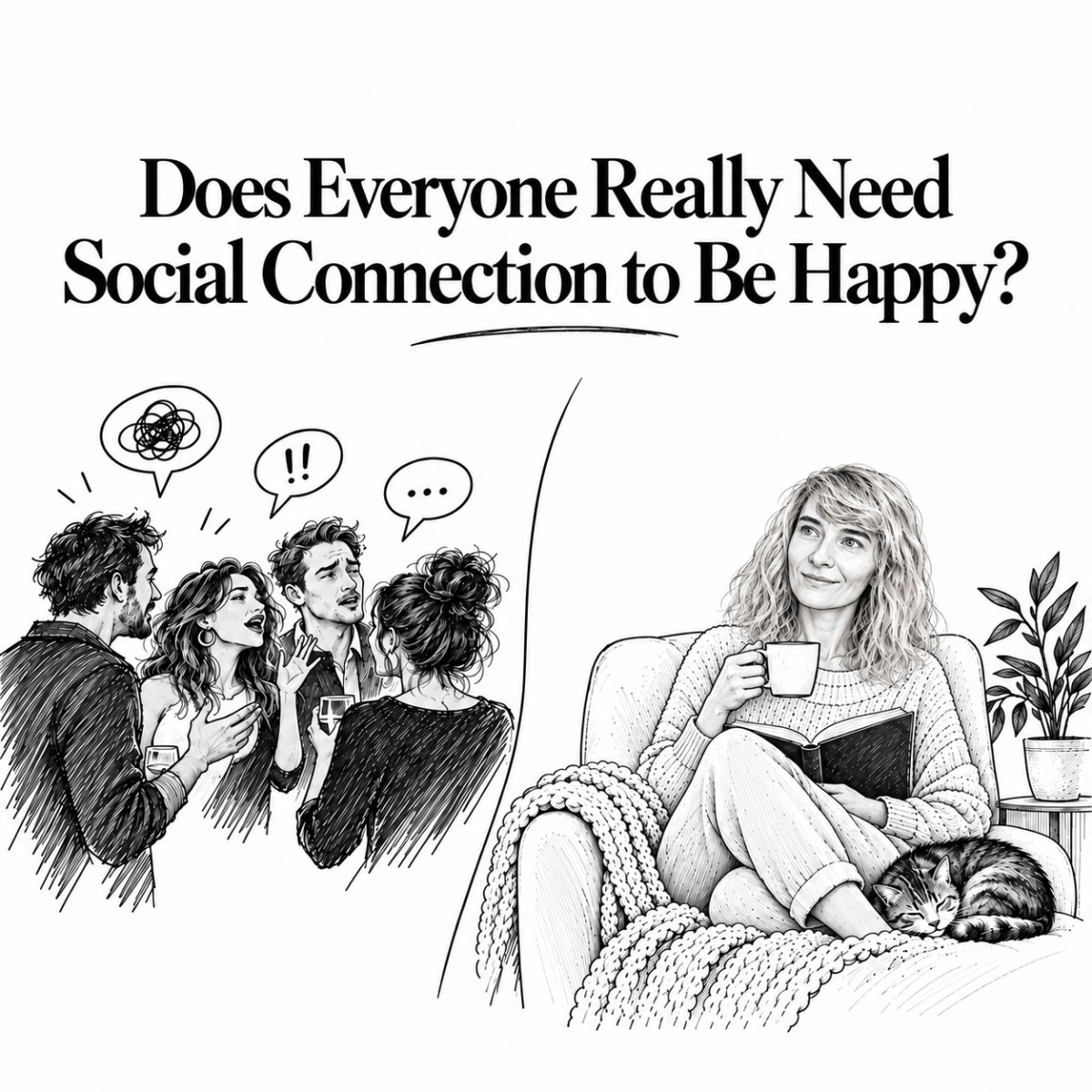
I am extraordinarily happy on my own. I never run out of ideas for what to do with my free time, and boredom is practically a foreign concept to me. I am creative, introspective, endlessly curious and increasingly hungry for life. Recently, I caught myself wishing I could live long enough to accomplish all the dreams accumulating in my mental departure lounge. I still have approximately sixty countries to explore, the Camino de Santiago to walk, my own Outlanga movement to launch, webinars about midlife reclamation to create, and my Dothleen compositions to release into the vast virtual ether. I want to write, experiment, explore, learn, invent and occasionally make a complete fool of myself while attempting something new. My greatest fear is no longer that I might end up alone. It is that I might run out of time before I’ve had the opportunity to live all the lives I am itching to experience.
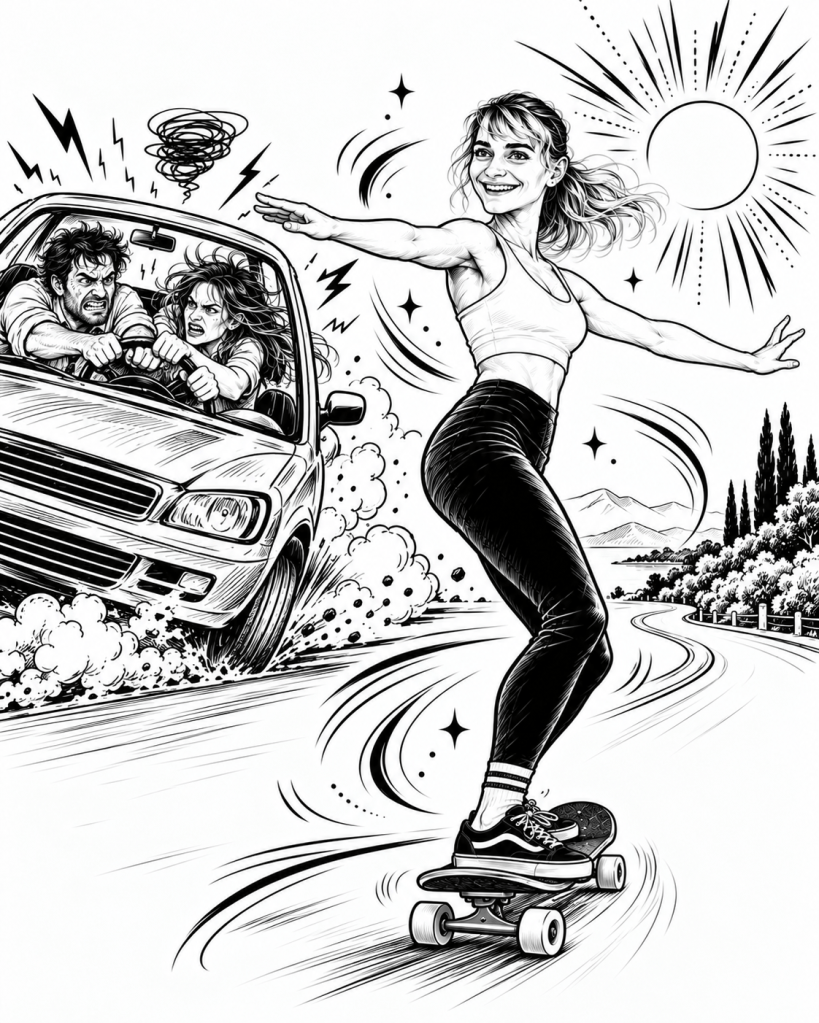
And the older I get, the more insatiable my appetite becomes. I recently bought a skateboard and have been practising at home, although I haven’t yet gathered the courage to venture outside and introduce the general public to my questionable skateboarding technique. I discovered the intoxicating beauty of running and completed my first half-marathon, propelled towards the finish line by crowds shouting my name. Now I’m training for my first full marathon, and the extraordinary thing is that running 42 kilometres no longer seems particularly extraordinary. I simply believe I can do it. I’ve also discovered calisthenics, playground bars and the delicious sensation of hanging from something like a human monkey. My latest fantasy involves buying a boat and taking a boating course. A boat! At this rate, by the time I’m sixty, I’ll either be sailing around the Mediterranean or attempting to make a dent in the Universe.
When Other People’s Lives Looked Better Than Mine
But I haven’t always been this exhilarated by my existence. There was a time when I felt dissatisfied with myself, despite having considerable freedom, abundance and plenty of opportunities to enjoy it. And the principal culprit was something so commonplace that it rarely receives the ridicule it deserves: comparison. I kept looking at other people’s lives and wondering whether I should want the things they had, even when those things had never particularly appealed to me in the first place. I was comparing my own private reality with somebody else’s public performance, and then wondering why I occasionally felt inadequate. It’s a rather absurd competition when you think about it. Imagine comparing your untidy kitchen, complete with dirty dishes and yesterday’s vegetable peelings, with a photograph of somebody else’s beautifully staged dining table. Naturally, their life looks better and more put together. They’ve carefully removed the rubbish before taking the picture.
I was perfectly happy travelling solo, exploring unfamiliar cities, eating whenever I fancied and changing my plans without consulting another living soul. Yet occasionally, when I saw a couple holding hands beneath the evening lights or enjoying a romantic dinner overlooking the sea, I would experience a fleeting pang of regret. Not necessarily because I wanted to be in a relationship, but because the scene seemed to represent something desirable, something I was apparently supposed to have. I was younger then, and considerably less familiar with the complicated dynamics, social scripts, emotional negotiations and unspoken expectations that can exist within relationships. I saw the lovely image without seeing the machinery behind it. I mistook the outward appearance of togetherness for evidence of happiness, overlooking the rather inconvenient fact that two people sitting opposite each other in a romantic restaurant might even more lonely as someone eating alone.
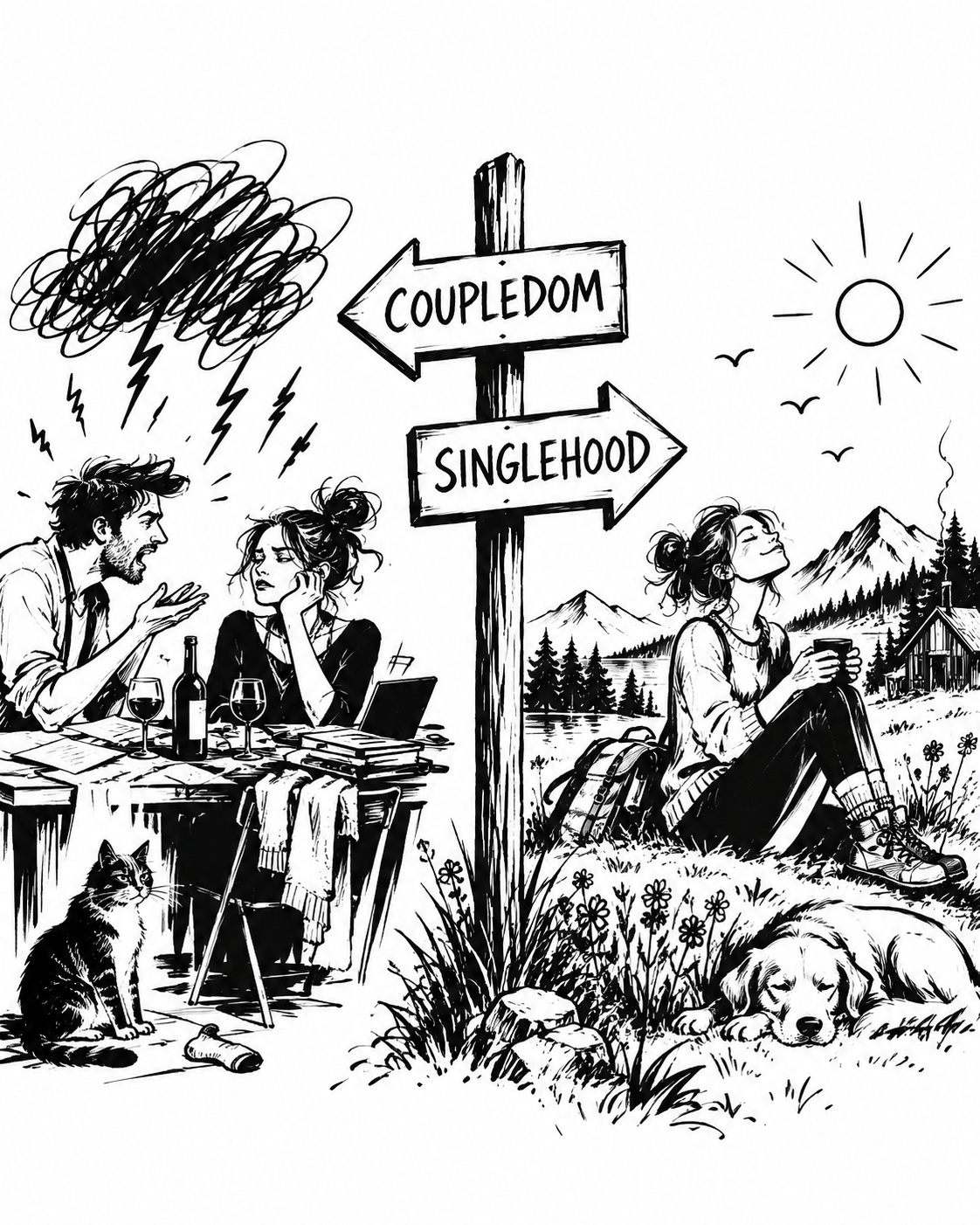
The more I travelled, observed and listened, the more suspicious I became of those immaculate pictures. Not because every relationship is miserable or every smiling couple is fraudulent, but because the public presentation of happiness tells us remarkably little about its private reality. I’ve witnessed couples strolling affectionately outside their hotels, holding hands, smiling and taking photographs against gorgeous backdrops, only to spend half the night arguing behind their bedroom doors. In some hotels, the walls were so ridiculously thin that I could hear every accusation, every jealous interrogation, every bout of guilt-tripping, every theatrical emotional escalation and every tearful exchange. I hadn’t paid for a relationship drama, but apparently it came free with the accommodation.
Romance in the Lobby, Warfare Behind Closed Doors
What astonished me wasn’t simply the arguing. People disagree, lose their tempers and sometimes behave badly. It was the extraordinary contrast between what I witnessed at night and what I saw the following morning. The very same couples who had spent hours tearing strips off each other would reappear outside the hotel, smiling sweetly for photographs, embracing beneath palm trees and presenting themselves to the world as two blissfully content human beings. Click! Another beautiful memory for the family album. Perhaps a romantic caption, a little heart emoji and a declaration about finding your soulmate. Meanwhile, I was standing there wondering whether I had imagined the previous night’s emotional battlefield. Apparently, a decent night’s sleep wasn’t essential to maintaining the appearance of a perfect relationship. A flattering camera angle was.
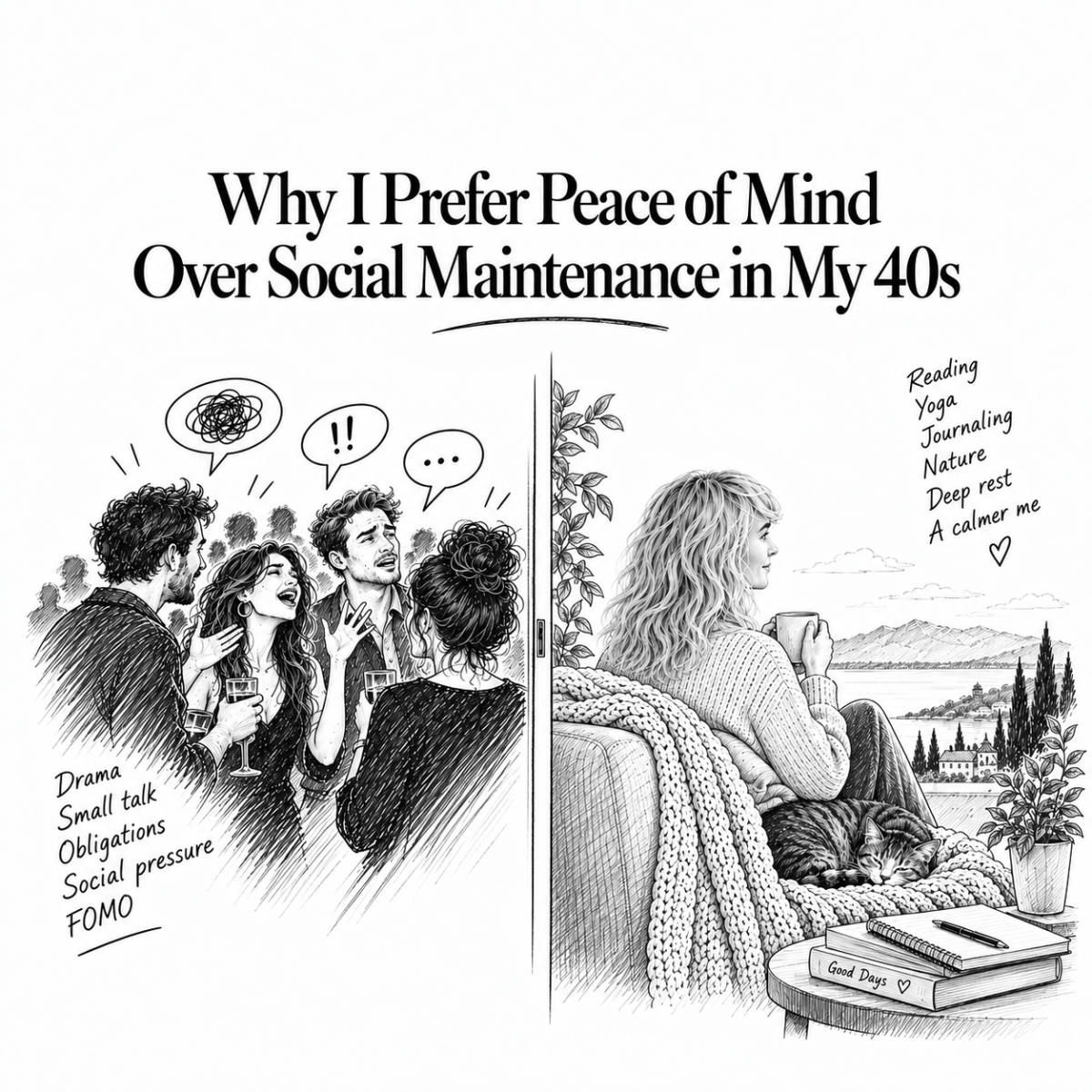
After several experiences like these, I developed my own little bedtime ritual. Whenever the accusations and emotional fireworks began next door, I would put in my earplugs, settle comfortably beneath the duvet and experience an almost luxurious sense of peace. No jealous interrogation waiting for me, no emotional negotiations, no passive-aggressive silences, no demands to explain why I had looked at somebody for three seconds too long. Just me, my thoughts and the glorious prospect of waking up whenever I pleased. I felt genuinely grateful for the tranquillity of my room and, more importantly, the tranquillity of my mind. Whatever was happening on the other side of the wall, I wasn’t required to participate. My happiness didn’t need a witness, a romantic caption or a second toothbrush beside the sink.
Of course, those experiences don’t prove that relationships are inherently unhappy. Plenty of couples genuinely love and respect one another, and some people find tremendous fulfilment in marriage and parenthood. Good for them. What I reject is the assumption that their arrangement should be universally desirable, or that a photograph of two smiling people somehow proves they’ve achieved a superior form of existence. A relationship isn’t a certificate of emotional wellbeing, just as being single isn’t evidence of personal failure. A wedding ring cannot tell you whether somebody feels loved, respected, frightened, trapped, fulfilled or desperately lonely. Yet society continues to treat marriage as a kind of gold medal in the Olympics of adulthood, while those of us who prefer to compete in an entirely different sport are expected to explain ourselves.
Green, Amber, Red — And the Shocking Truth About Feeling Safe at Home
I remember another experience that made me question the supposedly idyllic world of domestic bliss. Years ago, when I was still working a conventional nine-to-five job, I had to attend NVR training — Non-Violent Resistance training. At the beginning of the session, the trainer introduced an exercise that seemed innocent enough. We were asked to assess how safe we felt in different environments, including our workplace and our own homes, using a simple traffic-light system. Green meant safe and comfortable, amber meant uneasy or not entirely safe, and red indicated danger or a serious sense of insecurity. Straightforward, I thought. Surely home would be the easiest category of all? After all, isn’t home supposed to be our sanctuary, the place where we can finally relax, drop our defences and escape the demands of the outside world?
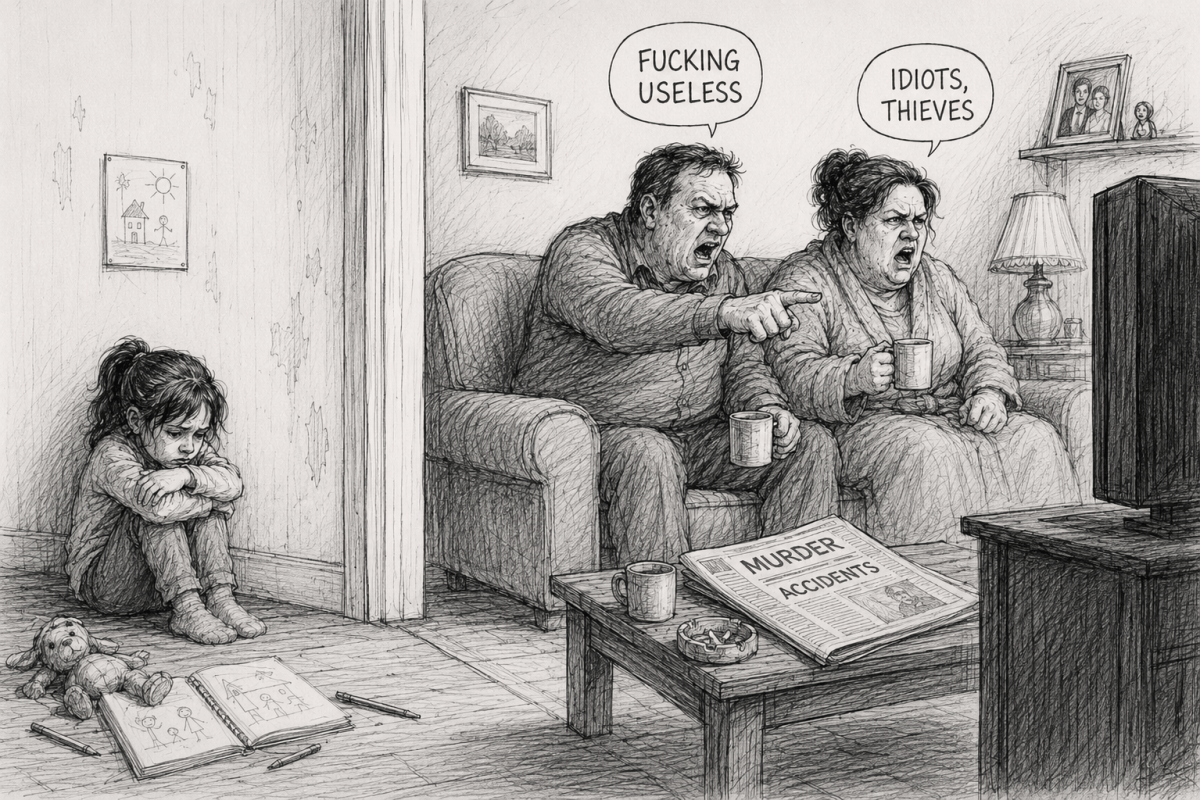
Well, I was in for quite a surprise. As my colleagues began sharing their responses, I was astonished by how many women had assigned amber or even red to their own homes. Their workplaces might have received relatively reassuring ratings, but their homes — the places supposedly associated with warmth, comfort, family and security — were another matter entirely. I remember sitting there in disbelief, wondering what on earth was happening behind all those perfectly ordinary front doors. What kind of domestic arrangements leave someone feeling less than safe in the very place where they sleep? What kind of emotional atmosphere turns a home into somewhere you approach with caution rather than relief? It was one of those moments when a simple classroom exercise suddenly revealed something profoundly unsettling about the world around me.
And there I was, with my gloriously uncomplicated GREEN for home. No hesitation, no soul-searching, no awkward deliberation over whether my domestic environment deserved amber or red. Green. Full stop. As you can probably imagine, I was single and living alone at the time. My home was my territory, my sanctuary, my little sovereign republic, with a population of one and remarkably few constitutional crises. I could close the door and know that nobody inside was going to interrogate me, undermine me, start an argument or demand an explanation for my existence. There was no emotional weather forecast to consult before entering the living room, no need to assess somebody else’s mood before deciding whether it was safe to relax. My home wasn’t a place I had to negotiate. It was the place where negotiations finally stopped.
Now, an exercise like this cannot tell us exactly why somebody feels unsafe at home. Not every amber or red response necessarily indicates an abusive relationship; there can be many sources of anxiety and insecurity. Nor does living alone automatically guarantee safety. But the contrast stayed with me. We hear so much about the loneliness of single people, the supposed emptiness of solitary living and the comforting security of having somebody waiting at home. Yet here I was, living alone and feeling entirely at peace, while a surprising number of women around me were unable to give their own homes a reassuring green. I couldn’t help wondering how many people were being congratulated on their successful domestic lives while privately longing for the kind of peace I took for granted.
It was an extraordinary reversal of the usual narrative. Society often looks at a woman living alone and imagines something missing: a husband, children, companionship, somebody to share the sofa with. But that training exercise made me think about what might be missing from some apparently complete households: tranquillity, autonomy, emotional security and the simple pleasure of feeling safe. Perhaps the question shouldn’t always be, “Don’t you feel lonely living alone?” Perhaps we should occasionally ask, “Do you feel safe living together?” Somehow, I suspect that question would produce considerably more uncomfortable answers.
Behind the Family Portrait: The Statistics Nobody Wants to Frame
In a previous post, I mentioned the horrifying case of a GP killed by her husband. What struck me was the apparent contradiction between the family’s outward circumstances and the terrible reality that emerged. A successful professional, a family home, children, the outward symbols of a comfortable and accomplished life. These are exactly the images that can provoke envy in someone who believes happiness must resemble a particular domestic arrangement. But photographs don’t tell us what happens when the camera is switched off. A beautiful house can contain extraordinary tenderness, ordinary domestic chaos or something deeply sinister. The size of the mortgage and the attractiveness of the furniture tell us precisely nothing about the emotional safety of the people living inside.
And domestic abuse is not some rare, sensational phenomenon confined to the occasional horrific newspaper headline. According to the Office for National Statistics, an estimated 3.8 million adults in England and Wales experienced domestic abuse in the year ending March 2025, including approximately 2.2 million women and 1.5 million men. There were also 111 recorded domestic homicides during that period, with women accounting for 75 victims. These are not merely fictional villains lurking in dark alleyways. In many cases, the danger exists behind perfectly ordinary front doors, among school photographs, family holidays, kitchen renovations and the everyday paraphernalia of respectable domestic life.
And these figures cannot capture every experience. Abuse is frequently hidden, minimised, rationalised or left unreported. Victims may fear retaliation, financial ruin, losing their children, social judgement or simply not being believed. Some are gradually conditioned into accepting behaviour they would once have considered unthinkable. Others feel ashamed that the relationship they publicly celebrated has become a source of misery. Imagine having spent years telling everyone how wonderful your partner is, only to find yourself trapped in a reality that bears little resemblance to the story you’ve been telling. The psychological burden must be enormous. It is difficult enough to confront an unpleasant truth privately, let alone dismantle an entire public narrative built around the illusion of happiness.
None of this means that entering a relationship is automatically dangerous or that every apparently happy couple is concealing abuse. But it does mean we should stop treating coupledom as an unquestionable guarantee of security, emotional fulfilment or personal success. Romantic love is not an exemption from human cruelty, and domestic respectability is not proof of domestic peace. The wedding photographs may be exquisite. The anniversary posts may be touching. The house may have a kitchen island the size of Luxembourg. None of those things can tell you whether somebody feels safe when the front door closes.
Born With a Silver Spoon — and Still Not Immune to Suffering
The same dangerous illusion extends far beyond romantic relationships. We look at wealthy, beautiful, successful people and assume that their circumstances must have purchased them some privileged immunity from emotional suffering. Consider Presley Gerber, the son of supermodel Cindy Crawford and businessman Rande Gerber. Born into extraordinary wealth, surrounded by celebrity, blessed with conventional good looks and introduced to the fashion industry at a remarkably young age, he seemed to possess many of the advantages people spend their entire lives pursuing. He had access to opportunities, connections and material comforts that most people could scarcely imagine. By the conventional standards of success, he appeared to have won the lottery before he’d even bought a ticket.
Yet Presley spoke publicly about depression, addiction and his struggles with mental health. He described the difficulties of navigating treatment and finding stability, and he died in September 2026 at the age of just twenty-seven. His death was investigated as a suspected overdose, although the official cause had not been confirmed at the time of writing. There is something deeply sobering about this contrast. From the outside, people might assume that someone born into such extraordinary circumstances would have every reason to be happy. But emotional suffering doesn’t consult your bank balance before entering your life. Nor does it disappear simply because your mother is a supermodel, your home is magnificent or your holidays take place in destinations most people only see on television.
And he is hardly the only example of the enormous gulf between public achievement and private struggle. Fashion designer Kate Spade built an internationally recognised brand associated with colour, elegance and playful sophistication. Anthony Bourdain travelled the world, discovered extraordinary food, met fascinating people and appeared to enjoy the kind of adventurous existence many of us dream about. Both died by suicide in 2018. Their deaths shocked people partly because their outward lives seemed so enviable. But professional success is not an antidepressant, fame is not a substitute for emotional wellbeing, and a passport full of exotic stamps cannot guarantee peace of mind. Their stories do not tell us everything about their private experiences, and it would be presumptuous to claim otherwise. They do, however, expose the poverty of our assumptions about what a successful life must feel like from within.
Celebrity culture is particularly skilled at manufacturing the illusion of perfection. We see flawless faces, immaculate bodies, designer wardrobes, luxurious houses, adoring partners and endless opportunities. What we don’t necessarily see are panic attacks, relationship breakdowns, substance misuse, eating disorders, body-image difficulties, loneliness or the relentless pressure of public scrutiny. Some celebrities speak openly about these experiences; others understandably keep their struggles private. Wealth can purchase comfort, specialist treatment, privacy and countless opportunities, but it cannot guarantee that somebody will feel comfortable inside their own mind. And constant scrutiny may add its own peculiar burdens. Imagine having millions of strangers dissecting your appearance, speculating about your relationships and treating your personal difficulties as entertainment. I struggle to think of anything less conducive to tranquillity.
Who Exactly Is Driving Your Life?
Which brings me to a question I wish more people would ask themselves before enthusiastically merging their lives with somebody else’s: who is going to hold the steering wheel? Who decides where you’re going, how fast you’re travelling and which turning you take when the road suddenly becomes interesting? Are you going to occupy the same vehicle and spend years fighting over the controls? Will one person drive while the other sits in the passenger seat, occasionally offering unsolicited directions? Or will you travel in separate vehicles, along neighbouring lanes, enjoying each other’s company without surrendering the freedom to take a different exit?
I know perfectly well that healthy relationships can involve shared decision-making, compromise and mutual respect. Two people can negotiate a route without turning every crossroads into a constitutional crisis. But that arrangement has never appealed to me as much as the glorious simplicity of travelling independently. I don’t want to negotiate the itinerary of my own existence. If I wake up tomorrow and decide I want to spend three weeks exploring the Balkans, learn to sail, launch a movement combining dance and yoga, or dedicate a ridiculous number of hours to a creative obsession, I want the freedom to do precisely that. I don’t want to submit a proposal, consult a committee or wait for somebody else’s annual leave to align with my enthusiasm. Life is short enough without turning every spontaneous impulse into a bilateral agreement.
My life is my lane. My body is my vehicle. My mind is my navigation system. And I am the driver. I take responsibility for the wrong turns, the occasional potholes and the times when I enthusiastically accelerate towards something that turns out to be a spectacularly bad idea. But at least those mistakes belong to me. I can change direction without asking permission, stop at an unexpected viewpoint or abandon the motorway altogether in favour of a winding country road. I don’t need someone else’s approval to justify my destination. And if I crash, I’d rather know that I was the one holding the steering wheel than spend the next decade wondering why I allowed somebody else to drive me into a ditch.
The Most Dangerous Comparison Is With a Life You Don’t Actually Want
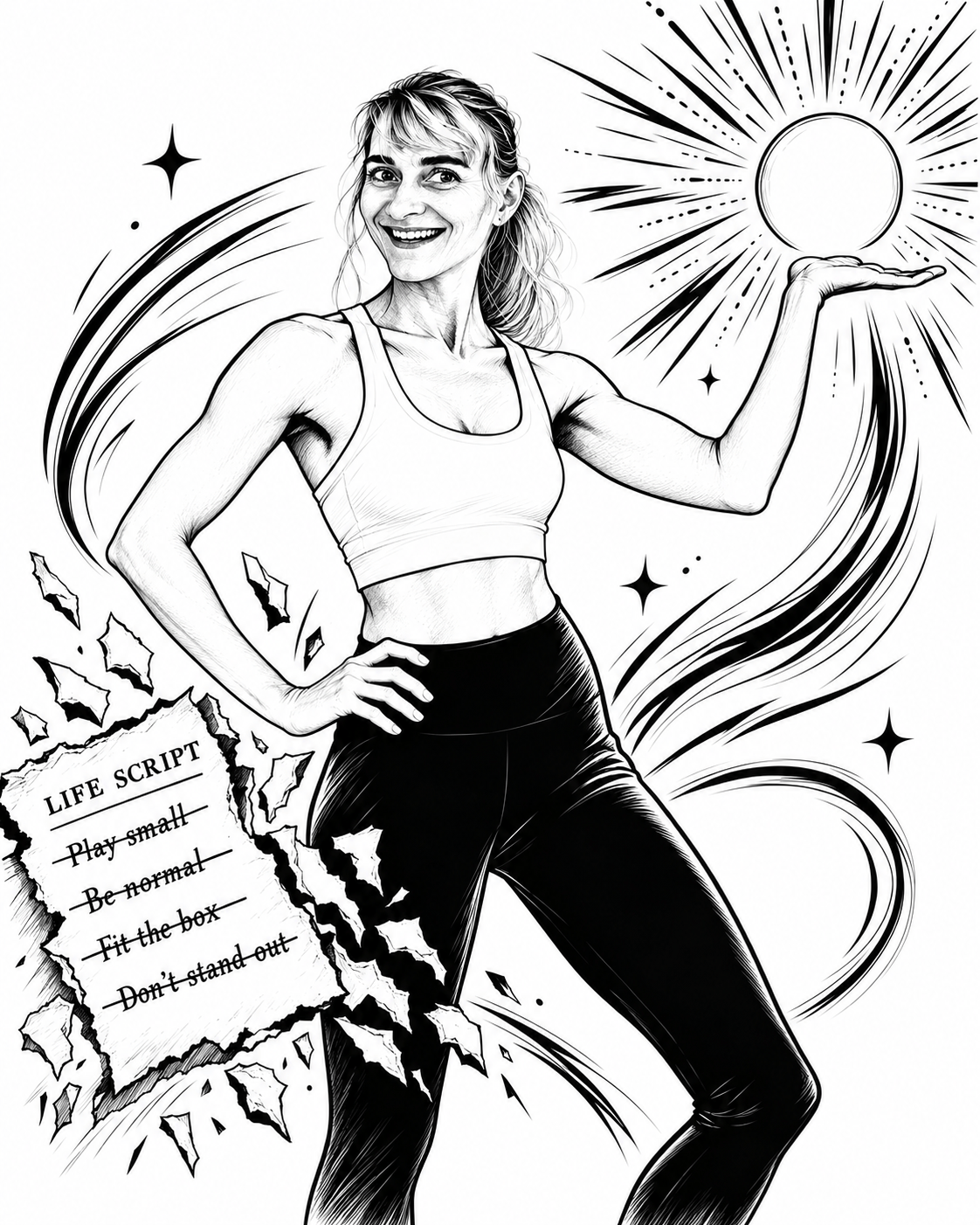
What I find almost comical now is how much time I once wasted feeling inadequate because other people possessed things I didn’t even want. I could be genuinely delighted with my freedom, only to experience a sudden pang of dissatisfaction when confronted with somebody else’s romantic dinner or beautiful family photograph. It’s as though I had been persuaded to envy a prize I had never entered the competition to win. Why should I envy someone’s marriage when I don’t particularly want to be married? Why should I feel deprived of motherhood when raising children has never featured among my ambitions? Why should I measure the success of my life by a checklist written by people whose priorities are entirely different from mine?
This is perhaps the most insidious aspect of social comparison: it can make us forget the difference between what genuinely nourishes us and what we’ve been conditioned to admire. Society supplies an assortment of ready-made ambitions — find a partner, buy a house, reproduce, climb the career ladder, acquire respectable furniture, upgrade the car, photograph everything — and then acts bewildered when somebody decides to spend their money travelling, their weekends hanging upside down from playground bars and their evenings producing experimental music. Apparently, adulthood is supposed to involve becoming increasingly sensible, predictable and domesticated. I seem to be travelling enthusiastically in the opposite direction, and I cannot recommend the scenery highly enough.
The liberation began when I stopped asking whether my life resembled other people’s and started asking whether it resembled the life I actually wanted. The answer became increasingly exciting. I had time, ideas, energy, independence and an appetite for experiences that showed no signs of diminishing. I didn’t need to acquire somebody else’s dreams to validate my own. I needed to stop treating my unconventional choices as deficiencies and start recognising them as expressions of who I am. That doesn’t mean every decision I’ve made has been wise, or that solitude protects me from sadness, illness or disappointment. It simply means I no longer interpret the absence of conventional milestones as evidence that something important is missing.
Stop Admiring the Vehicle. Look at the Driver.
So the next time you’re scrolling through photographs of apparently perfect people living apparently perfect lives, ask yourself a few questions. Are they genuinely happy? Perhaps they are. Perhaps they aren’t. Perhaps they’re experiencing a complicated mixture of joy, frustration, anxiety, affection, resentment and uncertainty, like most human beings. You cannot possibly know from a photograph. And that’s precisely the point. Stop treating other people’s carefully selected moments as evidence that their entire lives are better than yours. A smiling couple on a beach is a smiling couple on a beach, not a peer-reviewed study of marital satisfaction. A luxury house is a building, not a certificate of psychological wellbeing. A glamorous career is an occupation, not a guarantee of happiness.
And while you’re admiring everybody else’s vehicles, don’t forget to maintain your own. Look after your body, feed your mind, develop your abilities, protect your peace and keep your curiosity alive. Make your vehicle strong, agile, resilient and perhaps a little eccentric. Mine is increasingly sporty, occasionally sweaty, usually full of ideas and apparently developing an alarming appetite for marathons, skateboards, boats and monkey bars. I have no intention of parking it permanently in somebody else’s driveway merely because society thinks that’s where a respectable middle-aged woman’s vehicle belongs. I’ve spent too long learning how to drive it, and there are far too many fascinating roads I haven’t explored yet.
At forty-three, I don’t feel as though life is winding down. Quite the opposite. I feel as though I’ve only recently learned how to start the engine properly. The more I discover, the more I want to experience, and the less interested I become in acquiring the decorative accessories of somebody else’s definition of success. Perhaps I won’t visit all sixty countries on my list. Perhaps I’ll never become a competent skateboarder, and perhaps my future boating career will consist of drifting along a river looking slightly discombobulated. But at least those dreams are mine. I’d rather spend the rest of my life pursuing my own improbable dreams than waste another decade envying somebody else’s supposedly perfect reality.
So keep your eyes on your own road. Choose your own destination. Look after your vehicle. And whatever you do, don’t hand over the steering wheel simply because everybody else seems to be travelling in pairs. After all, you’re the driver — and this is your one and only ride.





Leave a Reply