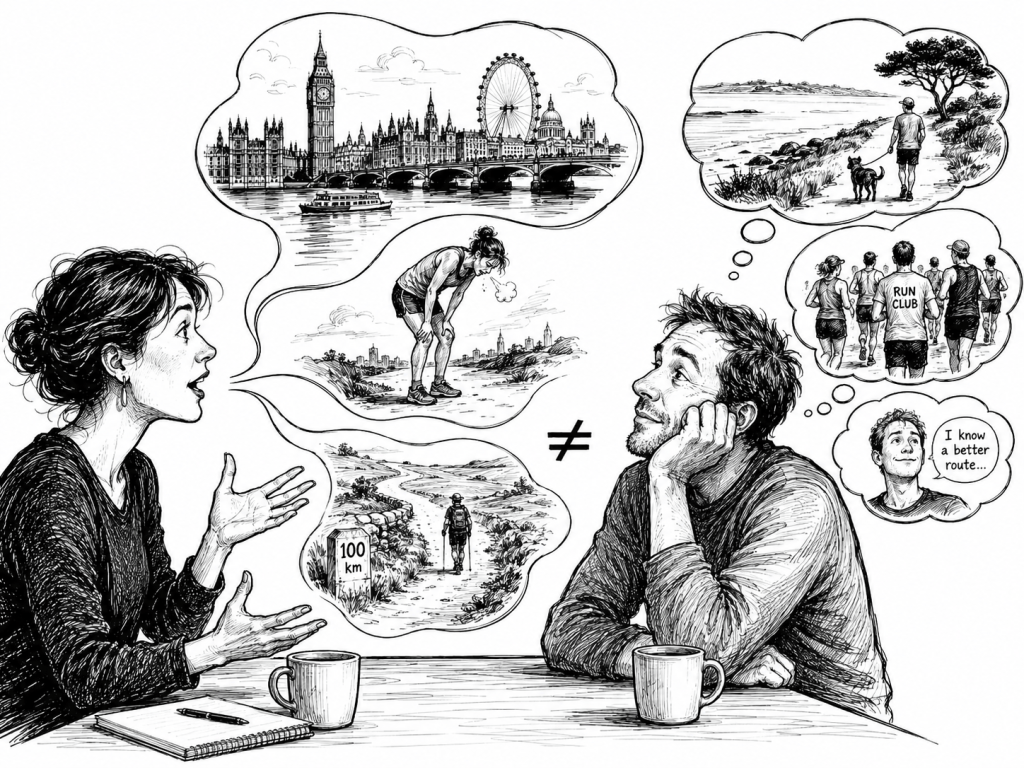
We like to think that communication problems happen because people use the wrong words. They misunderstand a sentence, miss a detail, phrase something clumsily, or fail to explain themselves clearly enough. But I have started to think that the deeper problem is often much simpler and much more frustrating: many people do not really listen or attune themselves to their interlocutor. They hear enough to recognise the topic on the surface, then immediately retreat into their own associations, opinions, experiences, conclusions and solutions. The conversation continues, but the person who originally spoke — and the meaning of what they were trying to communicate — has been pushed aside. Good communication requires more than hearing and commenting on selected vocabulary. It requires the temporary ability to leave your own head. You have to try to understand what another person is excited about, frustrated by, curious about or trying to explore before deciding what you want to say in return. That sounds obvious, yet in ordinary conversation it seems surprisingly rare.
You Said London. They Heard “Somewhere to Walk”
I once wrote enthusiastically about London after one of my 30 km walks there. I was intoxicated by the city: the architecture, the diversity, the Thames, the constantly changing neighbourhoods, the sheer amount of visual and human stimulation. I was not merely reporting that I had walked somewhere. I was expressing delight. London had given me a particular feeling, and that feeling was the entire point of what I had written. The response I received was essentially: what about our local Alderwick Shore? Then came a description of walks there with his dog. I remember staring at it thinking: what on earth does Alderwick Shore have to do with anything I just said? There is nothing wrong with our local Alderwick Shore, obviously, but that was not the issue. The issue was that my enthusiasm for London had been flattened into the category of “places where a person can walk locally.” The architecture, inspiration, atmosphere, river, diversity, unpredictability and pleasure I had described had been eradicated completely. I had been talking about being dazzled by a capital city, and somehow the conversation had been redirected into somebody else’s dog walks by the shore and his local pride. This is what poor communication often looks like. The listener catches one noun or one activity — in this case perhaps “walking” — and responds to the noun instead of the meaning.
You Said Burnout. They Heard “Running”
The same thing happened when I mentioned that I was beginning to experience running burnout. I had been running a lot and the activity was starting to lose some of its freshness. Again, I was describing an internal state. The important word was not “running.” The important word was “burnout.” The suggestion I received was that I should join a running club. More running. More structure around running. More people with whom to run. It was almost impressively opposite to what I had just communicated. This tendency to jump immediately to solutions is often presented as helpfulness, but a solution offered before the speaker has been understood is frequently useless. If somebody says, “I am exhausted by X,” suggesting a more organised version of X does not demonstrate problem-solving ability. It demonstrates that you heard the subject but missed the message, meaning, entire context. Sometimes the most intelligent response is not a recommendation at all. It is simply recognising and validating what has been said: “Yes, I can see why you might be getting tired of it.” Once that understanding exists, perhaps solutions can come later. But without it, advice becomes conversational noise.
You Said 100 Kilometres. They Heard Themselves
My favourite example came when I wrote about wanting to test my endurance by attempting a 100-kilometre walk. I was fascinated by the question of whether I could eventually exhaust myself. I walk long distances and often discover that I still have energy left. The challenge interested me as an experiment: where are my limits? What happens at 40 kilometres? At 60? At 80? Would there finally be a point at which my body said, absolutely not, we are finished? The response somehow became a comment about how exercise helped him feel better mentally, followed by encouragement to “keep it up.” I was baffled. I had not been discussing exercise as a mental-health intervention. I had not asked whether exercise was beneficial. I had not even been complaining. I was describing an endurance experiment and my curiosity about my own physical limits. Yet my specific idea disappeared and the response became a statement about the other person’s experience. And this, I think, is one of the biggest communication failures of all: some people listen only until your story gives them an opportunity to tell theirs.
Conversation Is Not Conversational Ping-Pong
We are often taught to keep conversations going by relating what another person says to something from our own lives. In moderation this can create connection. Someone tells you about India and you mention that you once travelled there too. Someone talks about losing a pet and you share that you understand because you experienced something similar. Personal experience can be a bridge. But the bridge becomes a bulldozer when every subject is immediately dragged back towards the listener. You say, “I love London,” and they tell you about their walks with the dog at Alderwick Shore in our city. Running is starting to exhaust me psychologically,” and they tell you which running club you should join — ideally, of course, the very one they have joined themselves. I say, “I wonder whether I could walk 100 kilometres,” and they tell you how exercise affects their mood. At that point you are not having a conversation. You are supplying prompts for somebody else’s monologue. The strange thing is that people doing this may genuinely believe they are engaging with you. They recognise the topic. They contribute something related to it. There is a reply, therefore there must have been communication. But communication is not merely tossing some random sentences. Two people can talk for twenty minutes while barely meeting intellectually or emotionally at all.
Active Listening Requires Curiosity
Active listening is often described in almost therapeutic language: nodding, maintaining eye contact, paraphrasing, asking open questions. Those techniques can be useful, but I think the real foundation is simpler: curiosity, authentic engagement and open-mindedness. Are you actually curious about what this person means? If somebody tells you they adore London, do you want to understand what exactly they adore about it? If somebody says they are experiencing running burnout, are you interested in why? If somebody wants to walk 100 kilometres, do you wonder what attracts them to such an extreme challenge? Curiosity changes the response automatically. Instead of saying, “There are nice walks locally near Brackenford,” you might ask, “What is it about London that gives you that feeling?” Instead of “Join a running club,” you might ask, “Do you think you need a break from running?” Instead of telling someone how exercise improves your own mental health, you might say, “A hundred kilometres is enormous — what do you think will happen when you get beyond the distances you already know you can handle?” Now we are communicating.
Emotional Attunement Is Not Mind Reading
There is another element people often miss: emotional attunement. This does not mean being psychic, endlessly validating everything somebody says, or responding with therapy-speak. It simply means noticing the emotional tone of what has been communicated. Delight should usually be met with some recognition of delight. Frustration should be recognised as frustration. Curiosity should be met with curiosity. Grief should not immediately receive a five-point improvement plan. If I tell you I have fallen in love with London, I am probably not requesting information about alternative coastal walks in our city. If I tell you I am bored with running, I probably do not require recruitment into a running club. If I announce that I want to test myself over 100 kilometres, “exercise is good for you” is so broad that it barely touches what I have said. Responding intelligently means identifying the layer beneath the literal subject.
Perhaps We Are Trained to Talk, Not to Listen
I suspect part of the problem is that modern social life rewards talking far more visibly than listening. We are encouraged to have opinions, tell stories, promote ourselves, contribute, perform, post, explain, advise and demonstrate that we have something to say. A person who speaks confidently looks socially competent. A person who listens exceptionally well is much less conspicuous. So people become skilled at waiting for their opening. They are not listening with the question, “What is this person trying to communicate?” They are listening with the question, “What can I say next?” The difference is enormous. One form of listening is outward-facing. The other is essentially rehearsing while somebody else speaks.
The Person in Front of You Is Not You
Perhaps the most basic communication skill is accepting that another person’s internal world may be dramatically different from your own. They may value things you find pointless. They may be excited by something that bores you. They may pursue challenges you would never attempt. They may dislike solutions that would work perfectly for you. Their priorities, motivations and emotional responses do not have to make sense according to your personal operating system. The job is not to immediately recycle their experience into something familiar. The job is to understand it before you answer. That is surprisingly difficult because it requires a small act of surrender. For a few moments, your experiences are not the reference point. Your preferences are not the standard. Your solutions are not automatically relevant. Another person’s world gets to exist without being translated into yours. And perhaps that is why genuinely good communicators are so memorable. They leave you with the unusual sensation that you were not merely heard. You were actually met.
Privacy note: Alderwick Shore and Brackenford do not exist. I invented both names to disguise the real locations involved.











Leave a comment